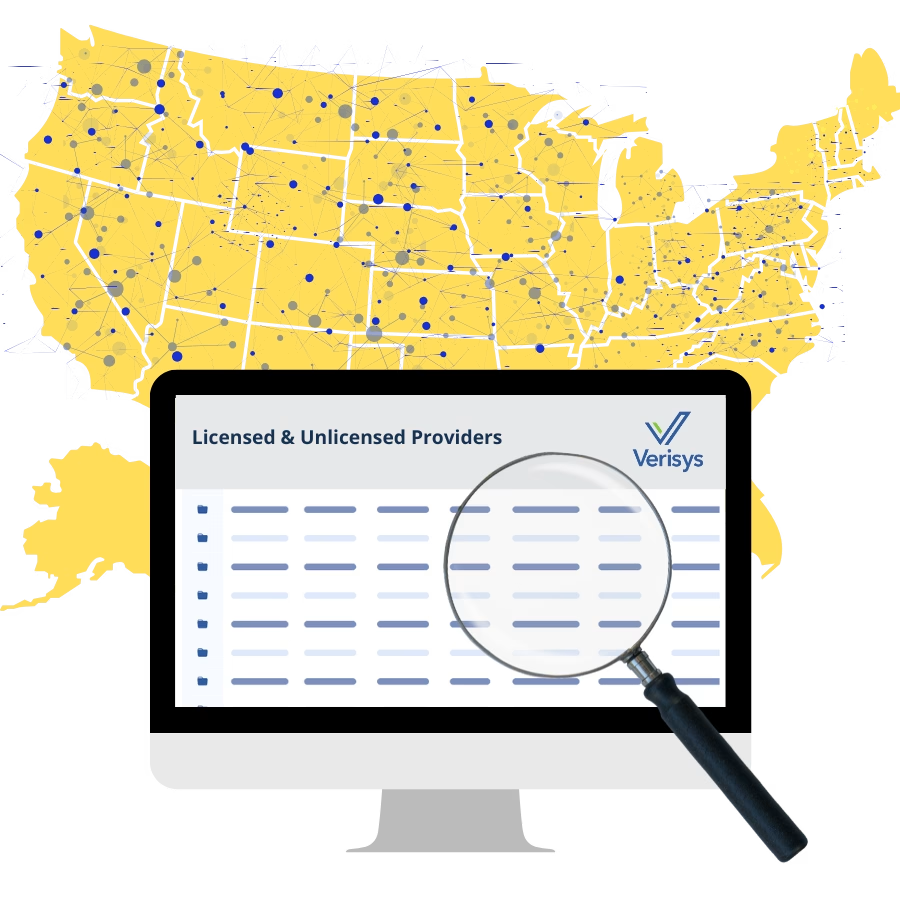
Hospital credentialing verifies a practitioner’s qualifications, including licensure, education, training, sanctions history, and other required information. Privileging is a separate process that authorizes the practitioner to perform specific services at the hospital, while payer enrollment determines whether claims may be submitted to a health plan. These workflows are connected, but they should not be treated as interchangeable.
This article examines where credentialing breaks down across hospital operations and how more accurate, current provider data can help. You’ll also find practical strategies for tightening credentialing workflows and what to evaluate when selecting a credentialing data or services partner.
Why Hospital Credentialing Is So Complex
Hospital credentialing verifies that a practitioner meets the qualifications required for appointment to the medical staff. The process may include primary-source verification of licensure, education, training, board certification, sanctions history, professional liability information, and other required credentials. Incomplete or inconsistent processes can delay a practitioner’s start date, create gaps in medical staff oversight, and increase accreditation or compliance risk.
Hospital credentialing covers a wide range of healthcare professionals, each with different qualifications and licensure requirements. These professionals include:
- Physicians
- Physician assistants and advanced practice registered nurses, where applicable
- Allied health practitioners subject to credentialing or privileging
- Locum tenens practitioners
- Telemedicine and Behavioral Health practitioners
Credentialing is part of a broader medical staff lifecycle that may include initial appointment, primary-source verification, privileging, reappointment or recredentialing, ongoing monitoring, and committee. Each function is distinct, but all depend on accurate and current provider information.
Medical staff services, HR, compliance, and operations all need access to that data, but they frequently work from separate systems and separate copies of the same provider file.
For multi-campus or multi-state health systems, complexity increases when teams must coordinate provider records, applications, committee reviews, and privilege decisions across facilities. The organization’s medical staff structure, governing arrangements, and applicable accreditation requirements determine how those processes are managed.
Common Credentialing Challenges Hospitals Face
These challenges are often connected. A provider-data issue in one department can surface downstream as a verification delay, documentation gap, or compliance concern in another.
Manual Verification and Fragmented Provider Data
Credentialing staff often check state licensing boards, the NPDB, OIG, and certification bodies one source at a time. Provider information sits scattered across spreadsheets, shared drives, and paper files in between.
The 2024 CAQH Index identified a $20 billion savings opportunity from transitioning remaining manual healthcare administrative transactions to electronic workflows. Although the estimate is not specific to hospital credentialing, it illustrates the broader cost of manual healthcare administration.
Automation alone cannot resolve inaccurate or fragmented provider data.
Closing that gap requires primary-source license verification from issuing boards that include monitoring, rather than periodic manual lookups that may not reflect changes published after the verification date.
Lengthy Provider Onboarding Timelines
Incomplete applications mean repeated outreach for missing documentation. Committee scheduling and governing-body approval can add further delays.
Even when an application is complete, a credentialing file may remain open while staff wait for a certifying body, licensing board, or other primary source to respond. Committee scheduling, privilege review, and governing-body approval can create additional dependencies before the practitioner is ready to begin work.
These bottlenecks show up as:
- Delayed time to treat patients or begin scheduled work
- Reduced patient access, particularly in specialties already short-staffed
- Provider frustration that can weaken recruitment and retention
Coordinating Credentialing, Privileging, and Workforce Compliance
Hospitals and Health Systems manage several related but distinct provider-oversight workflows. Medical staff services may oversee credentialing and privileging for physicians and other licensed practitioners, while HR manages workforce screening and license verification for employees. Compliance teams may monitor sanctions and exclusions across practitioners, vendors, contractors, and other entities.
These populations may rely on overlapping identity, licensure, sanctions, and exclusion data, but they do not always follow the same approval process. A coordinated data strategy can help departments use consistent provider information while preserving the ownership and requirements of each workflow.
Keeping Credentials Current After Approval
Licenses, DEA registrations, board certifications, and professional liability coverage may expire on different schedules. Sanctions, exclusions, disciplinary actions, and restrictions can also be published between formal credentialing or reappointment reviews.
For example, a physician’s DEA registration may lapse after the initial credentialing process, potentially affecting the practitioner’s authorization to prescribe controlled substances. Without an effective monitoring process, the change may not reach medical staff services or other operational teams promptly.
Reappointment and re-credentialing schedules vary according to applicable laws, accreditation requirements, payer contracts, organizational policies, and medical staff bylaws. Regardless of the formal review schedule, ongoing monitoring helps hospitals identify relevant changes after monitored sources publish updates so staff can investigate and respond.
Maintaining Documentation and Audit Readiness
Depending on the hospital’s accreditation, program participation, and regulatory obligations, surveyors or auditors may review whether credentialing and privileging policies were followed and whether required verification records are complete, current, and accessible.
Missing verification records, unresolved expirations, inconsistent policies, and documentation that cannot be retrieved during a review can undermine audit readiness. Conducting a structured credentialing-file review before an audit or survey can help hospitals identify and resolve these gaps.
How Credentialing Inefficiencies Affect Hospitals and Health Systems
When credentialing data and processes break down, the effects extend beyond the medical staff services department:
- Patient access – A practitioner awaiting required credentialing, appointment, or privileges may not be ready to begin providing services, potentially delaying patient access or specialty coverage.
- Financial performance – Delays in credentialing, privileging, or payer enrollment can postpone a practitioner’s start date or reimbursement. Because each process follows its own requirements and timeline, hospitals need visibility into where a file is actually delayed.
- Administrative burden – Staff may repeatedly check primary sources, reconcile records, or follow up on missing information instead of focusing on exceptions that require judgment.
- Provider experience – Long or unpredictable onboarding timelines can create provider frustration and weaken the recruitment experience.
- Compliance risk – A sanction, exclusion, license action, or other status change may remain undetected until the next formal review. Continuing to rely on outdated provider information can create patient-safety, operational, payment, or audit exposure, depending on the nature of the finding.
Strategies for Improving Hospital and Health System Credentialing
Hospitals or Health Systems looking to streamline healthcare credentialing tend to focus on a few specific changes:
- Establish an authoritative provider-data framework so departments use consistent, traceable information across connected systems.
- Automate primary-source verification using accurate, standardized provider data.
- Standardize workflows and assign clear ownership across medical staff services, HR, compliance, and IT.
- Build exception handling into the process, so staff spend time on the cases that actually need judgment.
- Set up automated reminders so teams receive advance notice of license, certification, and registration expirations.
- Use ongoing monitoring—not only periodic recredentialing—to identify sanctions, exclusions, and other status changes after monitored sources publish updates.
- Deliver verified provider data into existing credentialing, HR, compliance, and operational systems through APIs, secure file exchange, or portal access.
What to Look for in a Hospital or Health System Credentialing Solution
Improving credentialing does not always require replacing an organization’s existing technology. Hospitals or Health Systems should first evaluate whether their current systems receive accurate, verified, and sufficiently current provider data.
Evaluate any credentialing software or data partner against these criteria:
- Coverage for the practitioner and entity populations relevant to the organization across the jurisdictions where it operates
- Primary-source verification drawn directly from issuing authorities rather than self-reported data
- Ongoing monitoring of relevant licenses and controlled-substance registrations, NPDB updates where applicable, and sanctions and exclusions through FACIS® and other appropriate sources
- Configurable workflows, reporting, and exception handling that match how the hospital’s teams actually work
- Data delivery through APIs, secure file exchange, or an existing platform, instead of requiring every team to adopt a separate system
- The ability to scale across facilities, states, and provider populations without requiring administrative effort to grow at the same rate as provider volume
- Audit-ready documentation, with expiration and status change alerts built in
Building a More Efficient Hospital and Health System Credentialing Process
Reliable hospital credentialing services depend on accurate provider data, consistent workflows, and timely visibility into status changes. Hospitals and Health Systems can improve performance by strengthening coordination across medical staff services, HR, compliance, and operations while maintaining clear distinctions between credentialing, privileging, workforce screening, and payer enrollment.
Verisys supports in-house, hybrid, and outsourced credentialing models with primary-source verification, FACIS® sanctions and exclusions screening, license and credential monitoring, and flexible data delivery through APIs, secure file exchange, and portal access. This helps hospitals reduce manual work, maintain audit-ready records, and move qualified practitioners through credentialing more efficiently.