Healthcare organizations credential providers three ways: in-house, through a credentials verification organization (CVO), or a hybrid of both. The right choice depends on verification capacity, regulatory requirements, provider data quality, and integration needs, all covered below.
Understanding Credentials Verification Organization
A CVO performs primary source verification of healthcare provider credentials on behalf of healthcare organizations. While a CVO verifies and documents provider qualifications, the healthcare organization’s credentialing committee remains responsible for final credentialing decisions.
Typical verification process activities include:
- Education and professional training
- State licensure
- Board certifications
- Employment history and clinical privileges
- Malpractice insurance
- Sanctions and exclusions
Both the National Committee for Quality Assurance (NCQA) and The Joint Commission recognize CVO credentialing as an acceptable method for primary source verification. Health plans, hospitals, medical groups, pharmacies, and other healthcare organizations often partner with CVOs, including Verisys, to reduce administrative burden while supporting regulatory compliance.
What Healthcare Credentialing Software Provides
Credentialing software helps organizations manage credentialing workflows, but it does not perform primary source verification itself. Instead, these platforms organize tasks, centralize provider records, and improve visibility across the credentialing process.
Common capabilities include:
- Workflow automation: Assigns tasks and routes applications through credentialing teams.
- Provider data management: Maintains centralized provider records that support ongoing credentialing activities.
- Expiration monitoring: Tracks upcoming license, certification, and insurance renewals.
- Reporting and integrations: Provides dashboards, audit trails, and connections to HR, EMR, payer, and other operational systems.
These are all very helpful features, but even highly automated credentialing platforms still depend on accurate, verified provider data to support credentialing decisions.
Credentialing Software vs CVO: Key Differences
When comparing credentialing vs cvo models, the primary distinction lies in function: software manages internal tasks, while a CVO actually executes the primary source verification.
| Factor | Credentialing Software | CVO Services |
| Primary function | Workflow management | Primary source verification |
| Primary source verification | No | Yes |
| Internal staffing | Requires credentialing team | Reduces internal verification workload |
| Scalability | Depends on available staff | Easily accommodates changing volumes |
| Ongoing monitoring | Uses available provider data | May include continuous monitoring and verification services for providers, entities, contractors, vendors, and suppliers |
| Cost structure | Software licensing | Service-based pricing |
| Best fit | Organizations with experienced credentialing teams looking for a workflow platform | Organizations seeking outsourced verification expertise |
Combining both approaches tends to give organizations the most flexibility: internal teams keep control of workflows while a CVO handles verification.
When CVO Credentialing Makes Sense
Partnering with a CVO is often the best choice when organizations need additional verification expertise or greater operational capacity.
Common scenarios include:
- Limited internal credentialing resources
- Rapid provider growth or acquisitions
- High verification volumes
- Multi-state provider networks
- Complex regulatory requirements
Organizations pursuing NCQA certification or URAC accreditation may also benefit from working with a certified CVO. According to NCQA, organizations that delegate credentialing activities to a certified CVO receive relief from formal oversight review for credentialing elements covered by that certification, reducing administrative burden.
When Credentialing Software Is the Better Choice
Credentialing software is often the right investment for organizations with established healthcare credentialing teams that want greater efficiency while maintaining control over internal workflows.
Software is particularly valuable for organizations that need:
- Better workflow automation
- Centralized provider records
- Greater operational visibility
- Long-term scalability without outsourcing daily credentialing operations
Even in software-driven environments, provider data quality remains essential. Verified provider information must still come from trusted primary sources that integrate directly with provider credentialing platforms.
When Organizations Benefit from Both
Many healthcare organizations combine credentialing software with outsourced CVO services to create a more efficient credentialing program. In this model, CVO credentialing performs primary source verification while internal teams continue managing workflows, approvals, and credentialing committee decisions through their existing software.
The model becomes even more effective when verified provider data flows directly into credentialing platforms through APIs, secure file exchange, or online tools. Verisys delivers this data through a unified API for real-time integration, in addition to file exchange and portal access, so credentialing platforms don’t have to wait on manual uploads. This reduces duplicate data entry while ensuring credentialing teams work from current provider information. Continuous monitoring further strengthens this approach by identifying changes to credentialing data between re-credentialing cycles.
How to Evaluate the Right Credentialing Solution
Choosing the right credentialing strategy starts with understanding where your organization’s greatest challenges exist. Consider the following questions during your evaluation:
- Organization size: Can the solution support current and future provider volumes?
- Internal resources: Does your team have the capacity to perform ongoing primary source verification?
- Compliance requirements: Does the partner support recognized standards such as NCQA certification, URAC accreditation, HITRUST, and SOC 2?
- Integration needs: Can verified provider data be delivered through APIs, secure file exchange, or existing credentialing platforms?
- Growth plans: Will the solution scale with acquisitions, network expansion, or new provider populations?
Organizations should also evaluate turnaround times, source coverage, continuous monitoring capabilities, and data delivery options, not just workflow functionality.
Choosing the Right Credentialing Strategy for Your Organization
The right model comes down to three questions: who verifies, who maintains the data, and whether the workflow can scale with growth.
Organizations struggling with verification capacity often benefit from CVO services. Those with mature credentialing teams may gain greater value from workflow automation. Combining both is common for organizations that want verification handled externally while keeping workflow control in-house.
Regardless of the model selected, success ultimately depends on trusted provider data. Accurate, regularly monitored provider information supports faster credentialing decisions, stronger compliance, and more reliable payment integrity.
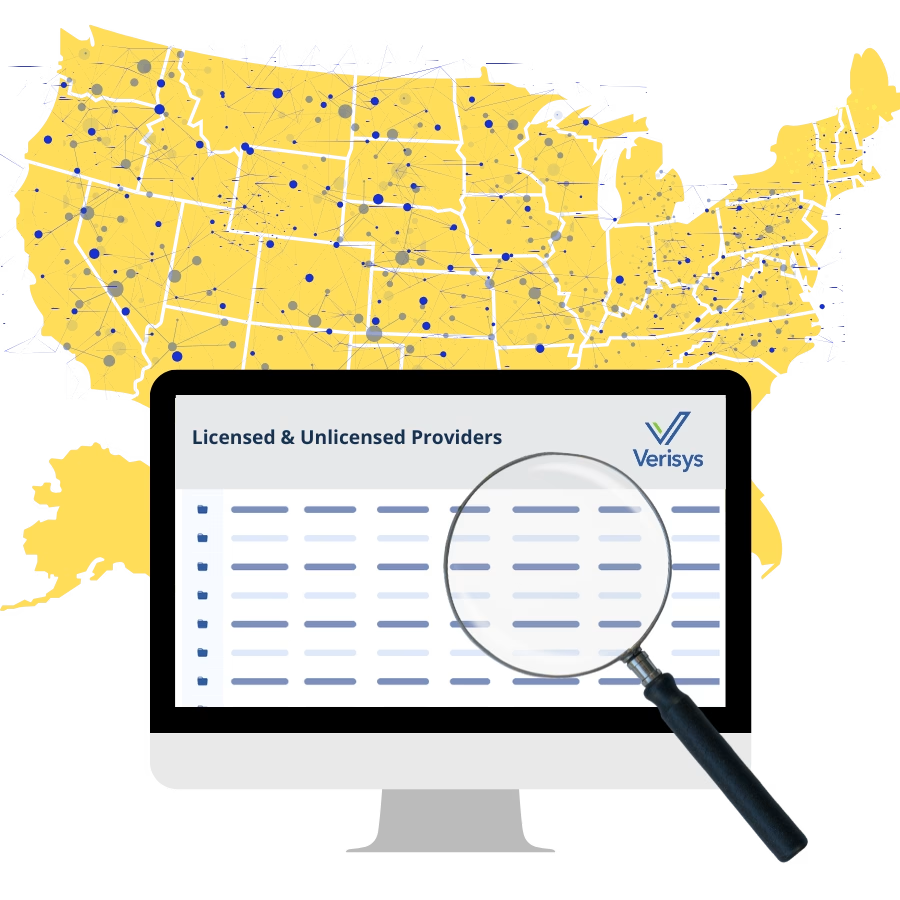
Verisys supports credentialing strategies across all three delivery models — outsourced, in-house, or hybrid — by delivering verified provider data, primary source verification, and continuous monitoring through Unified API, secure file exchange, or portal access. By helping healthcare organizations maintain accurate provider information across provider types and all 56 U.S. jurisdictions, Verisys strengthens credentialing, compliance, and payment integrity from a single trusted data foundation.