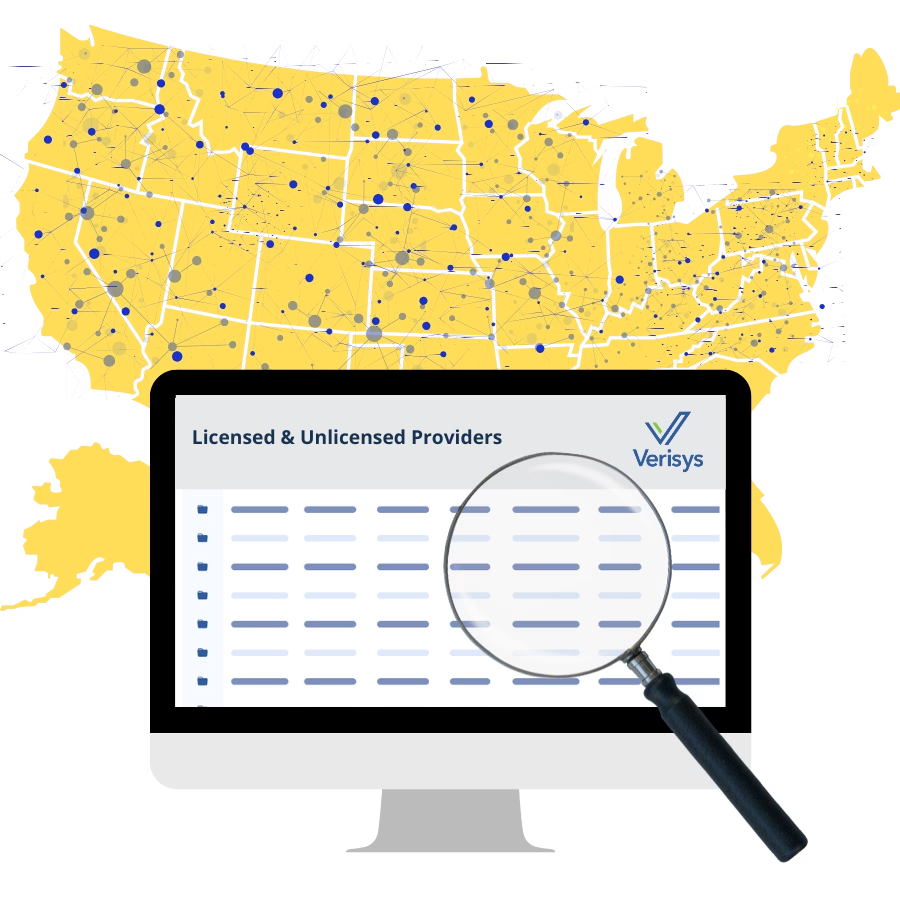
Healthcare credentialing and compliance teams often rely on several systems to manage provider information. License data, verification results, and monitoring updates may be stored in different places, creating additional work and making provider changes harder to track.
A credentialing API brings verified provider data into the systems teams already use. This can reduce manual lookups and duplicate data entry while giving credentialing and compliance teams more timely information. A successful integration still requires clear data mapping, business rules, exception handling, and ownership.
This guide explains how credentialing APIs work, what provider and compliance data they can deliver, and what organizations should consider before implementation. It focuses on provider data and regulatory verification rather than clinical data exchange or EHR interoperability.
How Healthcare APIs Work
An API allows one system to request data or services from another in a standardized format. In a provider credentialing workflow, an internal platform may submit identifiers such as name, date of birth, license number, or NPI and receive available verification or screening results. Results may return immediately or require source review and identity resolution, depending on the service and submitted data.
Comparing common delivery methods helps teams choose the right fit:
| Delivery Method | How It Works | Best For | Why It Matters |
| API | Automated requests and responses within existing systems | Real-time or high-volume workflows | Places data where decisions are made |
| Portal | User-driven searches and record review in a web interface | One-off or lower-volume needs | Provides access without a technical integration |
| SFTP/Batch Files | Scheduled transfer of bulk data files | Large rosters and periodic updates | Supports scale without real-time transaction architecture |
Delivery method should follow the workflow, not lead it. An API can reduce manual handling, but it cannot make up for incomplete source coverage, weak identity matching, or stale data. Organizations should evaluate data quality, monitoring cadence, and exception handling before choosing a delivery method.
IT teams may route API traffic through gateways or middleware to manage authentication, logging, and system access. Those controls matter, but the underlying provider data still determines whether a response is useful for a credentialing or compliance decision.
What Data Can Be Delivered Through an API?
The information available through a credentialing API depends on the provider’s source coverage, verification services, and data model.
Provider and Entity Data
Provider APIs may return identity attributes, demographics, NPI information, taxonomy, and other profile data. Entity records may cover facilities, pharmacies, group practices, suppliers, or other healthcare organizations. Individual and entity records should not be treated as interchangeable because the sources, matching rules, and verification requirements differ.
A well-designed integration should preserve those distinctions so the receiving system can apply the right business rules to each record type.
Licenses and Credentials
Depending on the service, API responses can include license status, issue and expiration dates, primary-source details, restrictions, disciplinary actions, certifications, and registrations. Automated delivery reduces the need for staff to search individual boards and re-enter results into another platform.
Ongoing monitoring extends that value beyond the initial verification by identifying reported changes in status, expiration, or disciplinary history after a provider has been approved.
Sanctions, Exclusions, and Eligibility Data
Federal and state data used for provider eligibility and exclusion screening may include:
- OIG and state Medicaid exclusion lists: Federal and state exclusion records
- SAM.gov and other debarment sources: Records that may affect eligibility for government-funded work
- Sanctions, adverse actions, and DEA status: Regulatory findings and controlled-substance registration information
- Medicare enrollment and opt-out information: Data used to assess federal program participation
A comprehensive sanctions data set should extend beyond a single federal or state list. Combining licensure, sanctions, exclusions, and enrollment data also supports eligibility checks at onboarding, re-credentialing, claims, and other decision points.
How APIs Support Credentialing and Monitoring
Healthcare APIs support credentialing, compliance, network, HR, and payment integrity teams by making verified findings available where provider-related decisions are made.
Common workflow uses include:
- Verification within existing systems: Teams submit requests and receive results without moving between applications or re-keying completed findings
- Re-credentialing support: Current primary-source results can return to the workflow when a provider reaches the next review cycle
- Ongoing monitoring: Reported license changes, sanctions, exclusions, and expiring credentials can trigger updates for review
- Provider eligibility screening: Relevant licensure, exclusion, DEA, and Medicare data can support prepayment or other eligibility checks
An API does not make the final credentialing, employment, or payment decision. It supplies data and findings so the organization’s approved rules and authorized teams can decide whether to accept, escalate, restrict, or investigate a record.
Healthcare background screening partners and compliance technology platforms can also embed verified provider data in their own products. This lets partners add healthcare-specific screening and monitoring without maintaining every primary-source connection.
What to Plan Before Integration
Start with the decision the integration needs to support. Define what triggers a request, which identifiers are required, what fields should return, and how the receiving system will handle a clear result, a potential match, or an incomplete record. This keeps the technical build tied to the operating process.
The implementation plan should identify the systems that send and receive data, the source of truth for each field, and whether the workflow needs real-time requests, scheduled files, or both. Teams should also document write-back rules, alert routing, audit evidence, retention requirements, and exception ownership after go-live.
Organizations should set aside the appropriate technical and operational resources before implementation begins. Establishing clear owners on both sides of the integration, along with a realistic timeline and implementation roadmap, helps keep development, testing, data mapping, and launch milestones on track. The roadmap should account for internal approvals, technical dependencies, testing requirements, and the resources needed from both the organization and the API provider.
Testing should include providers with multiple licenses, name changes, incomplete identifiers, entity records, and potential adverse findings. IT, credentialing, compliance, and the API provider should also confirm volume, rate limits, response times, and support procedures before production use.
Security and Data Governance
Credentialing data often contains personal and professional identifiers, even when it does not include protected health information. Security review should reflect the data exchanged, the systems involved, and the organization’s legal and contractual obligations. ONC’s API privacy and security guidance offers useful principles for healthcare integrations, including controlled access, protected transmission, and auditable activity.
Key controls to review include:
- Authentication and authorization: Confirm how systems and users are verified and how permissions are limited
- Encryption: Confirm protection for data in transit and, where stored, data at rest
- Least-privilege access and audit logs: Limit access by role and retain records of requests, responses, and administrative activity
- Retention, incident response, and service monitoring: Define retention rules, security-event procedures, failed-transaction handling, and data-quality checks
Not every credentialing API exchange involves protected health information. HHS explains that HIPAA applies to covered entities and business associates when they handle protected health information. The parties should determine whether HIPAA applies to the specific integration and document any required business associate or security obligations instead of assuming every provider-data API has the same requirements.
Organizations should also review independent assurance reports and relevant security certifications, such as HITRUST or SOC 2, where applicable. These materials support due diligence but do not replace a review of architecture, data flow, access, and contractual responsibilities.
Questions to Ask an API Provider
Credentialing and compliance leaders should compare data coverage, verification methods, matching, monitoring, delivery options, security, implementation requirements, and ongoing support before selecting an API provider.
Key evaluation questions include:
- What provider and entity types, jurisdictions, and primary sources are covered?
- Which identifiers are required, and how are records matched to the correct person or organization?
- Which results can return automatically, and which may require manual source review?
- Does the service support one-time verification, ongoing monitoring, or both?
- How quickly are source changes reflected, and how are monitoring updates delivered?
- How are potential matches, incomplete records, adverse findings, and disputes handled?
- What is the typical implementation timeline, and what factors could shorten or extend it?
- What technical and operational resources will the provider require from your organization during implementation?
- Will both teams have dedicated resources and an agreed-upon roadmap to keep implementation milestones on schedule?
- What rate limits, uptime commitments, response-time targets, and support procedures apply?
- Are SFTP, batch files, or portal access available when an API is not the right fit?
The answers should be specific enough to test during implementation. A provider should be able to explain its source coverage, update practices, match logic, exception process, implementation expectations, and delivery options without relying on broad automation claims.
Bringing Verified Data Into Existing Workflows
A healthcare credentialing API is only as useful as the data behind it. Organizations should evaluate whether provider and entity data is verified at the primary source, accurately matched, monitored for changes, and delivered in a format their teams can use.
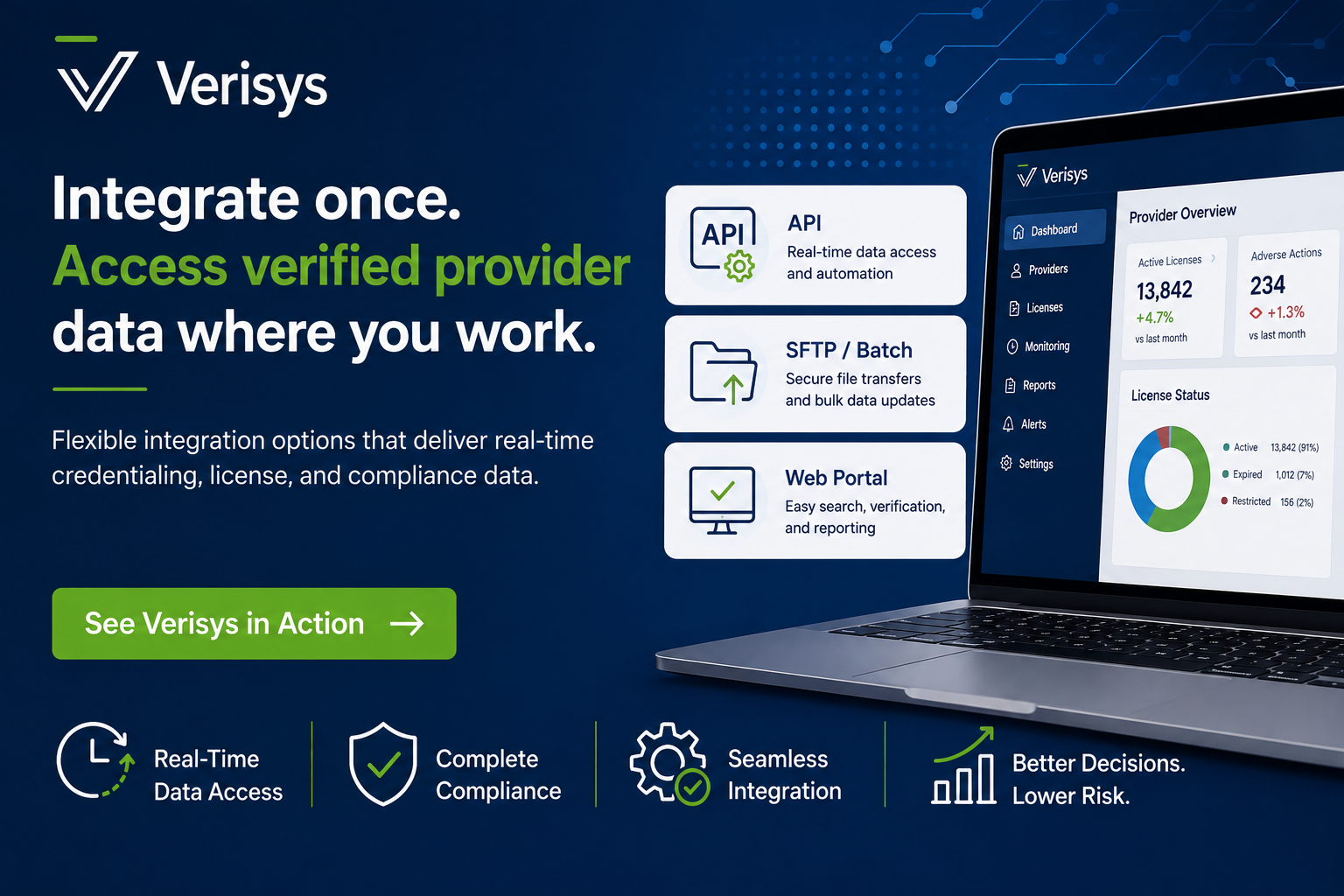
Verisys helps healthcare organizations and technology partners bring verified provider data into their existing credentialing and compliance workflows. Through API, SFTP or batch files, and portal access, teams can use licensure data, FACIS® sanctions and exclusions, and other regulatory information without replacing the systems they already rely on.
This flexible delivery model supports credentialing, workforce screening, ongoing monitoring, and payment integrity while giving teams a consistent data foundation across workflows.