Periodic credentialing is essential, but it confirms a provider’s status at a specific moment. A license, sanction, exclusion, registration, or disciplinary record may change weeks or months before the next formal review, leaving teams to make decisions with outdated information.
Real-time healthcare provider monitoring closes that gap with ongoing source checks, identity matching, and alerts when published records change. It does not replace required credentialing or recredentialing. Instead, it provides visibility between scheduled reviews, whether those reviews occur annually or every two to three years.
The Evolution of Provider Credentialing
Provider credentialing is built around an initial review followed by scheduled re-credentialing. Those reviews confirm qualifications, apply organizational criteria, and document approval decisions.
The problem begins after the file is approved: it starts aging immediately. For a large, multi-state population, manually tracking every license, sanction, exclusion, registration, and board action between review dates is difficult to sustain.
Continuous assessment for credentialing fills that interval with ongoing checks. The right cadence depends on how often each source publishes, the organization’s risk profile, and how quickly a change must be reviewed.
The need is not limited to one type of organization:
- Health plans managing network eligibility and provider status
- Health systems credentialing and monitoring clinical staff
- Pharmacies verifying pharmacist, technician, and prescriber authority
- Life sciences organizations screening healthcare professionals and related entities
The same approach can cover employees, contractors, vendors, and other populations when policy or regulation calls for broader healthcare background screening.
It may also include facilities and other provider entities. Those records bring their own matching, source-coverage, and escalation challenges, which a periodic file review may not catch in time.
Gaps Between Credentialing Cycles
Periodic reviews create three practical gaps that continuous monitoring can help address.
Delayed Risk Detection
Licensing boards, exclusion authorities, and other regulatory sources publish on their own schedules, not an organization’s credentialing calendar. A restriction, sanction, or exclusion can appear soon after a formal review closes.
Monitoring cannot make a source publish faster. It can shorten the time between publication and the moment the organization receives a record that needs attention.
Consider a provider added to the OIG List of Excluded Individuals/Entities in March while the organization’s next scheduled review is months away. The organization may not catch the change promptly, and claims connected to an excluded individual or entity may not be payable by federal healthcare programs.
Finding the record sooner gives the organization time to confirm the match, follow its policies, and limit further exposure. Depending on the facts, a missed exclusion can lead to repayment obligations, civil monetary penalties, or other enforcement risk.
Administrative Burdens
Manual primary source verification also ties up staff with repetitive work:
- Tracking expiration and renewal dates across provider populations
- Maintaining spreadsheets or separate work queues across departments
- Searching multiple licensing boards and regulatory sources for the same individual
As the population grows, repeated manual searches slow onboarding and pull experienced staff away from exceptions that actually require judgment. Automation should route changes and unresolved matches to the right reviewers, not replace their decisions.
Incomplete Visibility
A provider’s standing can change in several ways between reviews:
- New disciplinary actions or license conditions
- DEA or controlled substance registration changes
- Malpractice settlements, judgments, or other reportable events
- State board orders, probation, or practice restrictions
These changes are harder to manage when credentialing, HR, enrollment, payment, and compliance teams keep separate records. Each group may be working from a different version of the provider’s status.
Closing that gap requires data verified at the source, matched to the correct person or entity, and delivered to the teams responsible for action. Continuous monitoring is useful only when someone can act on the result.
What Is Real-Time Healthcare Provider and Entity Monitoring?
Real-time healthcare provider and entity monitoring means tracking credentials, eligibility indicators, and risk signals across relevant regulatory sources on an ongoing basis. Depending on the program, the monitored population may include providers, employees, contractors, facilities, suppliers, vendors, and other entities. Here, “real time” refers to how quickly a system processes and delivers a published change. The source itself may update continuously, daily, monthly, or on another schedule.
It should not be confused with remote patient monitoring, or RPM, which uses connected devices to track clinical measurements. Provider and entity monitoring focuses on licensure, eligibility, sanctions, exclusions, registrations, and other data used in credentialing, employment, contracting, payment, and compliance decisions.
Coverage varies by population and use case, but commonly includes:
- Licensure: State medical, nursing, pharmacy, and other board status confirmed through primary source healthcare license verification
- Sanctions and exclusions: Federal and state exclusion, debarment, and disciplinary sources
- Board actions: Orders, probation, restrictions, and other published adverse actions
- DEA and controlled substance registrations: Current authority and status, where applicable
- Program participation: Medicare enrollment, opt-out, or other eligibility indicators used in payment workflows
- Entity and vendor status: Sanctions, exclusions, debarments, and other published regulatory records affecting facilities, contractors, suppliers, vendors, and other entities
Benefits of Continuous Provider and Entity Monitoring
Continuous monitoring makes risk management an ongoing part of credentialing and compliance rather than limiting visibility to scheduled review cycles.
With verified data and clear follow-up procedures, the benefits of continuous monitoring in healthcare include:
- Earlier identification of changes – Alerts can flag newly published license, sanction, exclusion, or registration changes before the next scheduled review
- Stronger audit readiness – A record of checks, notifications, and resolution steps helps demonstrate how the organization monitors and responds to changes
- Reduced financial exposure – Earlier visibility into eligibility issues can help limit additional claims, payments, or remediation work
- Better patient and workforce protection – Current information supports timely decisions about employment, network participation, privileging, prescribing, and payment
Monitoring connects initial verification and screening with ongoing oversight, but the organization still reviews findings and makes credentialing, employment, contracting, network, or payment decisions.
Technologies Driving Real-Time Monitoring
Three capabilities work together to support effective real-time provider monitoring.
Automated Alerts
Configurable alerts tell designated teams when information changes or a potential match appears. An alert should identify the source, affected credential, effective date, and enough context for triage without another manual search.
Continuous Verification
Continuous verification checks sources according to the schedule on which they publish. A monthly source cannot produce daily source freshness. Programs should therefore distinguish among source update frequency, data acquisition frequency, and alert-delivery speed.
Speed is only useful when the underlying coverage and matching are reliable. Incomplete sources or incorrect matches create noise, rework, and unnecessary escalations.
Integrated Data Platforms
Integrated platforms normalize and match data, then pass changes into credentialing, HR, enrollment, payment integrity, or compliance workflows. Integration alone does not fix weak data; verified inputs and clear ownership still matter.
Implementing a Real-Time Monitoring Strategy
A real-time monitoring program works best when coverage, governance, and system integrations are defined before alerts begin.
Defining Monitoring Requirements
Identify the people and entities in scope, the credentials and risk indicators to monitor, and the jurisdictions that apply. Set the cadence based on source availability, contractual requirements, policy, and the consequence of missing a change.
Establishing Governance Policies
Specify who reviews each alert, how potential matches are confirmed, when a case is escalated, and what evidence is retained. Include procedures for false positives, disputes, and employment-screening obligations where they apply.
Integrating with Existing Systems
Send monitoring results to the systems where teams already work. APIs, secure file exchange, batch submissions, and portals can feed credentialing platforms, enrollment systems, HR tools, claims workflows, or compliance applications.
Using the same verified data across these workflows reduces duplicate monitoring and manual reconciliation.
The Future of Provider Credentialing
Scheduled credentialing and re-credentialing remain essential. They simply cannot provide continuous visibility into changes that occur between reviews or across multiple jurisdictions.
In practice, organizations need ongoing source monitoring, clear response procedures, and delivery methods that fit the systems teams already use.
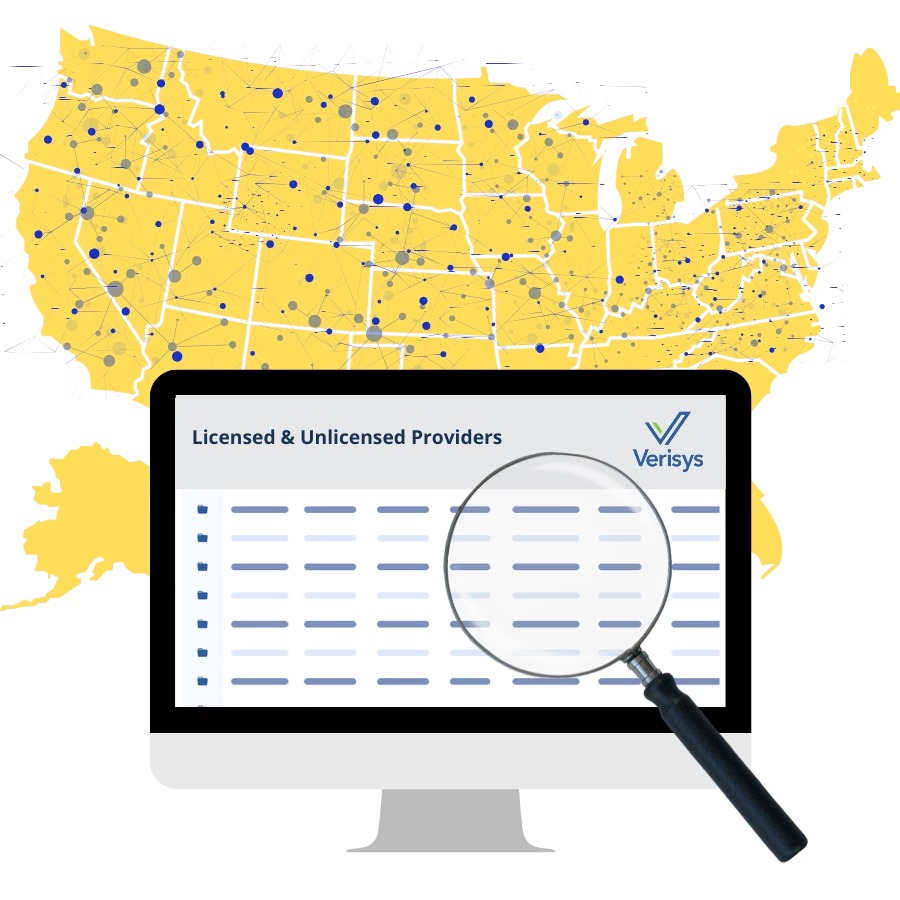
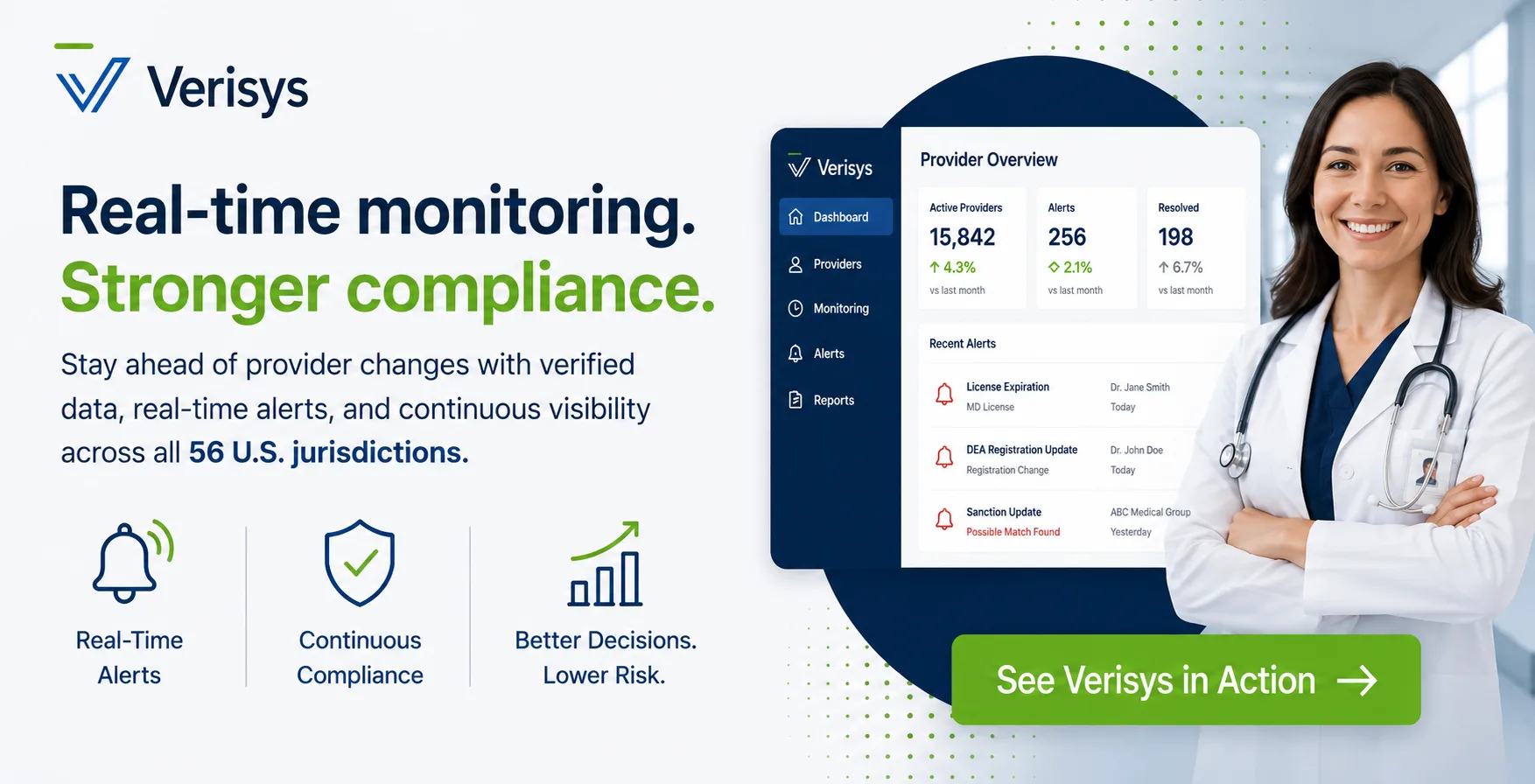
Verisys provides verified provider and entity data across licensure, sanctions, exclusions, DEA registrations, program participation, and other regulatory sources. Its monitoring solutions cover all U.S. states and jurisdictions and deliver results through APIs, secure file exchange, or a portal.
Health plans, health systems, pharmacies, life sciences organizations, and technology partners can act on changes sooner while keeping credentialing decisions in the hands of their own teams.