A healthcare provider’s credentials refer to their education, training, and the licenses or certifications they’ve earned before or during their career. ‘Credentialling’ is a little different, referring to the formal process—often conducted by a government agency or professional review board—by which a healthcare provider’s credentials are verified.
Credentials prove a health professional knows their field; credentialing allows them to provide healthcare and related services to others.
However, various jurisdictions—states, in particular—handle their credentialing processes differently. This article examines these jurisdictional variations in the US to help credentialing professionals and healthcare providers understand and streamline credentialing processes—especially for those operating across state lines.
What Is State-Based Credentialing?
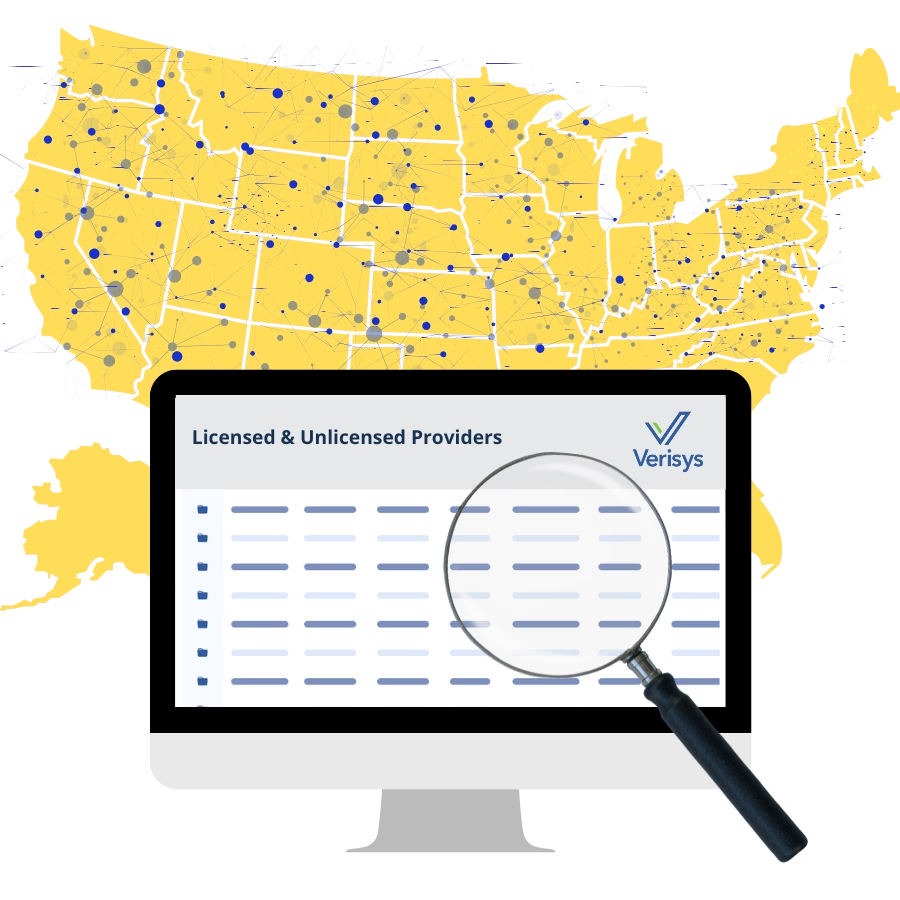
US provider credentialing is largely handled at the state level. That may make it seem like credentialing can occur in 50 different ways. Fortunately, provider and hospital credentialing by state is not quite that complicated, thanks to regional alignments, interstate compacts, and other factors.
Each US state—and some territories, like Guam, Puerto Rico, and the Virgin Islands—maintains at least one medical board responsible for credentialing healthcare providers. Nineteen states have also formed osteopathic boards, which operate separately from conventional medical boards. Collectively, the state medical and osteopathic boards are represented by the Federation of State Medical Boards (FSMB), which was formed in 1912.
The FSMB has developed both the Uniform Application, which simplifies preparing applications in multiple states, and the Federation Credentials Verification Services (FCVS), which stores different credentials relevant to multiple state boards. Taking advantage of these resources can help shorten application times.
Non-State Credentialing
Some federal agencies also manage licensure and credentialing requirements for specific purposes. One example is the eight-hour Continuing Medical Education (CME) training required by the Drug Enforcement Administration (DEA) for healthcare providers who prescribe controlled substances.
Similar to credentialing, health insurance networks (i.e., payers) require any provider who’s interested in contracting with them to compile and provide similar information about their credentials. This process is also known as ‘provider enrollment.’ Payers then verify the information and make a determination on contracting with the provider.
State credentialing allows healthcare providers to practice legally within a state; provider enrollment adds a provider to a given health insurance network, meaning the payer will cover some portion of an insured patient’s incurred expenses. Explore how Medicaid provider credentialing solutions support compliance for multi-state payer networks.
Why Credentialing Varies by State
Originally, the state-based credentialing system was developed because of the federalist structure of US law. Although the FSMB collaborated with the National Board of Medical Examiners (NBME) to develop the United States Medical Licensing Examination (USMLE) as a national assessment standard, credentialing is still managed at the state level. To simplify institutional oversight and meet regulatory standards, see how our hospital credentialing solutions empower credentialing teams nationwide.
The American Medical Association notes that state medical boards have trended toward a uniform list of requirements for licensure. Coalescing around a shared set of requirements led to the 2017 creation of the Interstate Medical Licensure Compact, which 42 states have agreed to honor. The Compact is intended to expedite processes, but states do not generally grant “automatic reciprocity.” This means individuals must still submit an application to each state in which they want to hold a license.
Colorado’s licensure regulations provide another example of expedited processes, as the Occupational Credential Portability Program is mandated to “implement the endorsement process in the least burdensome way necessary to adequately protect the public health and welfare.”
Telehealth Credentialing
Credentialing for telehealth services becomes complicated by the softening of state borders; with virtual appointments, patients can connect with healthcare providers from anywhere. Accordingly, some states have adopted different rules for telehealth practitioners, allowing them to earn a telehealth registration that functions across state lines.
Although states determine their own telehealth registration criteria—as with full medical licensure and credentialing—most require providers to meet the following:
- An unrestricted medical license from another state (must be current and valid)
- Clean disciplinary record with no proceedings
- Professional liability insurance in case of malpractice suits
Additionally, the provider cannot already have or open an office in the state, the provider cannot offer in-person treatment across state lines, and the provider must complete the annual reregistration and pay the appropriate state boards.
Examples of Credentialing Requirements by Region
Given the US’s tendency to group states regionally, it shouldn’t be surprising that medical boards in closer proximity tend to share certain characteristics. For example:
- Eastern States – Typically provide applicants with advanced electronic credentialing portals.
- Midwest – Midwestern states are known for enforcing stricter verification timelines than other regions.
- Southern – Often, Southern states will require in-state supervision or oversight for credentialing applicants.
- Western – Telehealth presence and infrastructure in Western states are usually more robust.
Navigating Multi-State Credentialing
With each state enforcing its own credentialing requirements, maintaining licensure across state lines can cause healthcare credentialing issues. For example, if a physician is working within a large health system that crosses state lines, they must keep up to date on all registrations, fees, training, and other criteria. And if the licensure in one state expires, that could result in considerable impacts to both the physician’s patients as well as the staffing and resources at some facilities.
Individual providers and groups (e.g., clinics, migratory patient populations) that operate in this manner benefit greatly from adopting a centralized credentialing platform to monitor all the necessary licenses and prevent expiries. However, it can still be beneficial to track renewals by jurisdiction to complete them in batches. If healthcare providers or groups intend to pursue cross-state expansion and multi-state credentialing, it’s strongly advised to begin planning early. Learn more about simplifying multi-state credentialing with our healthcare provider credentialing solutions.
Tools and Resources for Credentialing Teams
With the disconnected processes involved with credentialing—especially across multiple jurisdictions—teams responsible for maintaining registrations and licenses for healthcare providers need dedicated tools and resources. The following examples provide a solid foundation:
- State medical board directories – Documenting contact information will be the most important, but it’s also valuable to preserve copies of niche requirements, forms, publications, Board and Commission meeting minutes, or other materials.
- Universal Application – FSMB resources (including the FCVS) can equip healthcare providers with a central repository of credentialing information to make applications and recurring registrations easier.
- Credentialing software – Evaluate platforms that support automated processes, data centralization, automatic reminders, compliance monitoring, and report generation. Vendor credentialing by state and across jurisdictions benefits immensely from these solutions.
- Recurring checklists – State medical boards will require healthcare providers to periodically complete some credentialing processes to maintain their license. This might mean attending specific trainings or completing CME courses. Alternatively, it might mean submitting registration fees. Whatever cycle credentialing follows, be sure to thoroughly document the process and prepare a checklist to make sure nothing is overlooked.
Simplifying Credentialing Across Jurisdictions
There are many jurisdictions across the US—both states and territories alike. For healthcare providers, understanding their individual requirements and schedules can become rather tricky. Multi-state credentialing, in particular, is complex. Patients or provider groups can be negatively impacted if a license approaching renewal is left unnoticed and allowed to expire.
That’s why so many healthcare providers trust Verisys for various types of credentialing. Verisys’ suite of credentialing tools—tracking, datasets, real-time license verification, and more—simplifies administration, so that providers can focus on their patients and communities. Talk to an expert today to learn more.
Sources:
FSMB. Contact a State Medical Board. https://www.fsmb.org/contact-a-state-medical-board/
AAFP. New DEA training requirement: who has to do it, and how to get it done. https://www.aafp.org/pubs/fpm/blogs/inpractice/entry/new-dea-requirement.html
AMA Journal of Ethics. The Role of State Medical Boards. https://journalofethics.ama-assn.org/article/role-state-medical-boards/2005-04
Colorado Department of Regulatory Agencies. License Portability Program. https://dpo.colorado.gov/LicensePortabilityProgram
HHS. Licensing across state lines (Teleheath). https://telehealth.hhs.gov/licensure/licensing-across-state-lines