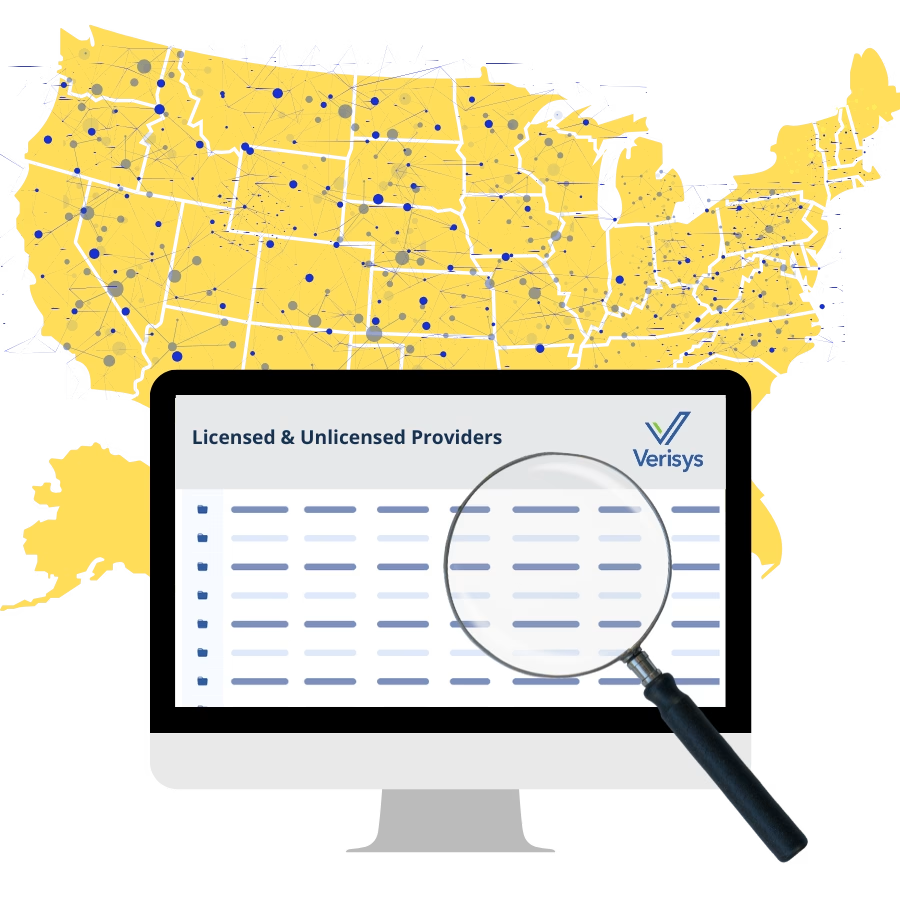
To expedite clinical progress and maximize the chances of positive outcomes, patients need to match with suitable, qualified healthcare providers. Provider data helps patients choose the right healthcare professional for their needs, but it’s often inconsistent. In fact, a 2024 study found that certain provider information is only accurate across 9% of directories.
Provider data validation is also critical for ensuring compliance with governmental regulations. Ultimately, accurate provider data enables timely, quality care and keeps organizations running smoothly and above board.
Healthcare, health plan, and health system providers are all responsible for healthcare data validation. With that in mind, let’s explore data validation in healthcare, identify its primary challenges, and outline best practices for maintaining up-to-date, accurate provider information.
What Is Provider Data Validation?
Put simply, data validation ensures the accuracy of key information about healthcare providers. This generally includes crucial data about the provider’s specializations, location, contact details, and more, including their:
- Scope of operations
- Personnel
- Credentials for available healthcare professionals
- Address
- Phone number
- Other contact information, such as emails and websites
Unfortunately, this data is often outdated or just plain wrong within healthcare directories. Phone numbers are accurate across as few as 9% of directories, while address information is only 11% consistent for certain fields of practice. Even operational specialties aren’t correctly listed for around one-third of providers—leading patients and healthcare organizations alike to wonder how such crucial data can be so inaccurate.
The data validation process in healthcare is a shared responsibility that falls on:
- Compliance teams
- Data governance departments
- Network managers
There are several methods these and other parties can use to collect and validate data. You can, for instance, browse mass databases like the Centers for Medicare and Medicaid Services’ (CMS’s) Provider Data Catalog, then contact listings to validate data accuracy. You can also search other directories or review patients’ Electronic Health Records (EHRs).
However, these processes can be time-consuming and still yield incorrect results. To expedite validation and ensure provider data accuracy, it’s often easier to partner with a trusted specialist who offers provider data management.
The Risks of Inaccurate Provider Data
Providing inaccurate data to a patient or populating directories with the wrong provider information can lead to:
- Outdated or incorrect provider records – A wrong address, email, or phone number can make a provider uncontactable, reducing or slowing patients’ access to timely, quality care.
- Compliance violations and financial penalties – Inaccurate provider information can lead patients and insurers to accidentally file false Medicare or Medicaid claims, which can result in fines up to three times actual damages plus $11,000. And intent to defraud isn’t necessary—violators can be penalized for negligence when submitting inaccurate claims.
- Erosion of trust with patients and payers – Inaccurate provider information frustrates patients and causes extra work for payers. Consistently providing false data can affect your perceived trustworthiness and cause customers to seek out other insurers, plans, or health systems.
While these issues permeate broad public databases and unrefined directories, proper data validation techniques reduce their risks to your organization.
How Data Validation Reduces Risk
Prioritizing provider data accuracy with proper validation reduces risk in a number of ways.
Ensures Regulatory Compliance
Alongside the CMS, provider data regulatory compliance is also governed by:
In conjunction with CMS, OIG prevents abuse and fraud within national insurance programs. Meanwhile, the NCQA focuses on upholding credentialing standards and verifying qualifications. Validation helps you comply with all of their regulations guiding provider data distribution.
Prevents Fraud and Abuse
Fraud and abuse don’t only affect insurance providers; they can also potentially expose patients to low-quality, unqualified healthcare providers. Unverified providers may not meet acceptable care standards or, even worse, falsify their medical credentials.
Validating provider information prevents patients from encountering unlicensed, unqualified providers. Contacting licensing boards to validate a provider’s credentials, for instance, stymies potential false claims and ensures patients receive high-quality care.
Improves Network Accuracy
Keeping an accurate, updated directory helps patients browse available providers to decide who best meets their needs. Validating information and curating high provider data quality ensures only active, verified providers appear in directories, making patients’ choices quicker, easier, and more secure.
Enhances Operational Efficiency
Validating provider information also improves operational efficiency for health plans, systems, and care providers by:
- Reducing rework – Inputting the correct details and credentials prevents having to rework older entries. If it’s right the first time, you only have to modify listings when providers update their qualifications, location, or contact information.
- Preventing claim errors – Improper provider information can cause claim errors, which need to be corrected before payout. Claim errors can also lead to regulatory penalties, adding more duties and paperwork to your team’s load.
- Minimizing administrative overhead – Validated data reduces time spent identifying errors, searching for correct information, and reassuring patients, minimizing total administrative overhead at your organization.
Common Barriers to Data Validation
Ultimately, the more accurate your provider information, the smoother your operations and the more likely patients are to trust your organization.
But to validate data as efficiently as possible, it’s important to avoid these pitfalls:
- Disconnected systems – Contact data may be stored in one repository while credentialing information and qualifications often live in a completely separate, disconnected database.
- Manual verification processes – Contacting individual providers to ensure the veracity of their data takes significant time and resources.
- Inconsistent data collection standards – A lack of data intake forms or robust directory fields can cause organizations to collect or share incomplete, inaccurate information, or varying degrees of data for different providers.
- Limited staff – Fewer organizational resources mean less time to commit to validation, especially labor-intensive tasks like data entry and manual verification.
- Outdated technology – Aging directories that require manual entry, pack minimal features, and offer lackluster support make data validation more tedious and difficult.
Luckily, health plan, system, and care organizations can overcome these issues by sticking to key validation best practices.
Best Practices for Reliable Provider Data Validation
To enhance your data validation process and ensure updated, accurate provider information:
- Adopt automated validation tools and open Application Programming Interfaces (APIs) – Automated validation tools remove the administrative burden from your team with automatic data entry, monitoring, and updates. Open APIs let you customize your data validation tools to fit your organization’s specific needs.
- Establish centralized provider data governance policies – Create guidelines on what information to collect upon inducting a new provider into your network. Outline key details like address, contact information, and specialization that must accompany every entry.
- Conduct periodic data audits and updates – Providers can move their location, update their credentials, or change their contact details at any time. Periodically audit your provider data to ensure it has the latest, most accurate information available.
Staying on top of data validation can be a full-time job that pulls your employees away from other, more pressing duties. Instead of managing provider information in-house, trust a reliable validation partner with industry experience to deliver accurate, up-to-date provider data as you need it.
Building a Culture of Data Integrity
Proper provider data validation prevents medical misrepresentation, minimizes fraud and abuse in insurance claims, and maintains organizations’ regulatory compliance. Practicing ongoing validation also improves patient and payer trust, expedites operations, and keeps your organization off the National Practitioner Data Bank (NPDB), which tracks malpractice.
The best approach to provider data management is proactive, structured governance over data intake and storage. With over 30 years in healthcare provider data verification solutions, Verisys is your trusted partner in validation. From credentialing solutions like healthcare license verification to in-depth healthcare exclusion screening, we ensure your provider data is up-to-date, accessible, and compliant with regulatory standards.
Sources:
National Library of Medicine. Characterizing physician directory data quality: variation by specialty, state, and insurer. https://pmc.ncbi.nlm.nih.gov/articles/PMC11256460/.
Centers for Medicare and Medicaid Services. Provider Data Catalog. https://data.cms.gov/provider-data/.
United States Department of Health and Human Services. Fraud & Abuse Laws. https://oig.hhs.gov/compliance/physician-education/fraud-abuse-laws/.
The Office of the Inspector General. A Roadmap for New Physicians. https://oig.hhs.gov/documents/physicians-resources/947/roadmap_web_version.pdf.
The National Committee for Quality Assurance. Provider Network Accreditation Requirements. https://www.ncqa.org/programs/health-plans/provider-network/standards/.