If there’s one thing healthcare organizations can count on, it’s changing regulations. Although credentialing and recredentialing standards were temporarily changed due to COVID, many regulations are returning to the former protocol. That’s why it’s important to understand primary source verification, methods of accessing primary sources, and how to get help with practitioner credentials verification if you need it to avoid any healthcare compliance issues.
For the medical staff services team at a hospital to properly verify a healthcare practitioner’s credentials, dozens of primary sources must be contacted directly, and those primary source organizations must then verify the credentials of the practitioner in question.
What is Primary Source Verification?
Primary source verification (PSV) is the process of confirming a healthcare practitioner’s credentials directly with the original issuing source. Instead of relying on self-reported data or third-party summaries, PSV ensures that the information—whether it’s education, licensure, certification, or work history—is confirmed at the source. This first-hand confirmation is the gold standard in any type of credentialing and is required by accrediting bodies like The Joint Commission, NCQA, and URAC.
In practice, this means that when a provider applies for privileges or employment, the hospital or credentialing organization reaches out to schools, licensing boards, certifying agencies, and other entities to verify that the provider’s qualifications are legitimate, current, and free from disciplinary action. It’s a labor-intensive process, but one that plays a critical role in ensuring patient safety and regulatory compliance with healthcare credentialing.
What Is Considered a Primary Source?
A primary source is any body, institution, or person who originally granted the credential that’s being verified. Because they have first-hand knowledge, these primary sources can confirm if the information claimed is accurate. Here are some examples:
- Medical schools verify completion of education.
- State licensing boards verify practitioner license type and status.
- An Office of Inspector General (OIG) search of the List of Excluded Individuals/Entities (LEIE) indicates if the licensee is excluded from participating in government-funded programs.
- The Centers for Medicare & Medicaid Services (CMS) Medicare and state Medicaid lists show practitioners who have opted out of those programs.
- The policy issuer for malpractice insurance verifies insurance coverage.
- Medical or dental councils verify the registration of their members and any other credentials required by law, healthcare regulation, or hospital policy.
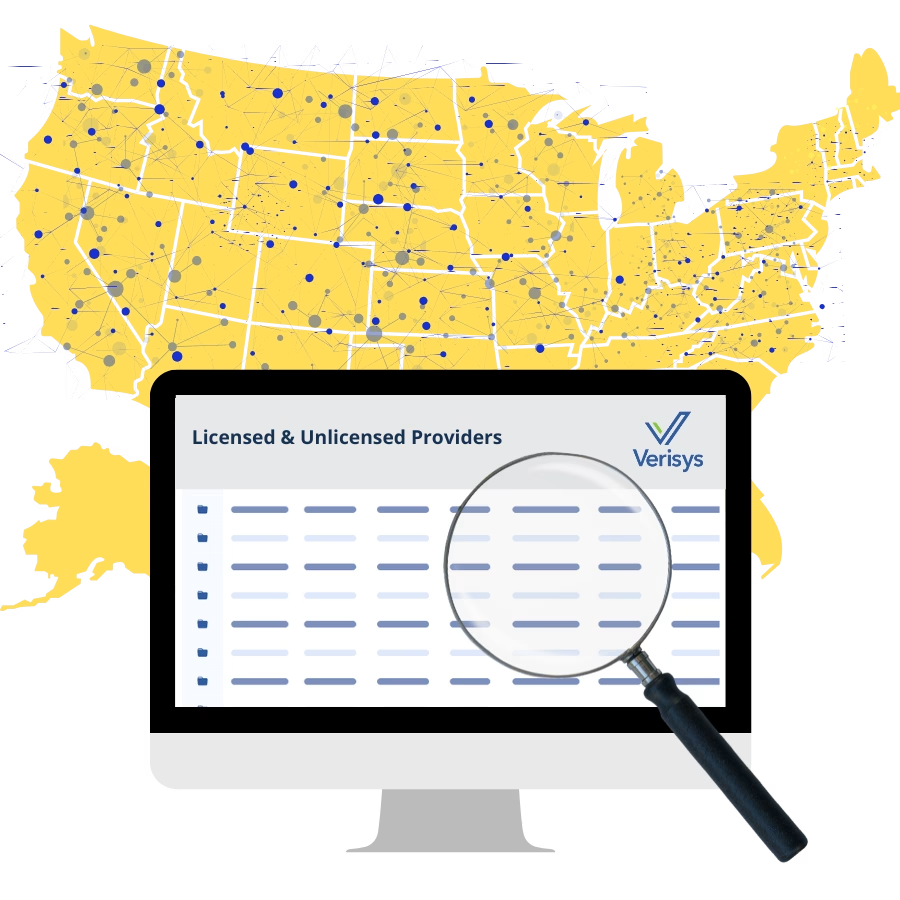
- And the list goes on.… For instance, Verisys checks more than 5,000 primary sources against its 10-million record database, FACIS®.
Government and Non-Government Sources
In addition to the sources listed above, the following practitioner information should also be obtained from these government primary sources:
-
- Sanctions by a State Medical Board
- National Practitioner Data Bank (NPDB)
- Drug Enforcement Administration (DEA) registration
- Controlled Dangerous Substance (CDS) registration
- Background checks
- Criminal history
- State board specialty certifications
- Military personnel records
The Joint Commission requires primary source verification for practitioners, but the following non-government sources may provide confirmation of the practitioner’s credentials as well. These can include:
-
- The American Board of Medical Specialties (ABMS) verifies physician board certification with records for more than 940,000 physicians. Information obtained from ABMS meets the requirements of The Joint Commission (TJC) and other federal agencies to qualify as a primary source for verification.
- The American Medical Association (AMA) Physician Masterfile contains information about 1.4 million physicians, beginning with their entry into medical school and continuing with medical school graduation and post-graduate certification information. The Masterfile obtains records directly from medical schools.
- The American Osteopathic Association (AOA) Physician Database verifies pre-doctoral education accredited by the AOA Bureau of Professional Education, post-doctoral education approved by the AOA Council on Postdoctoral Training, and Osteopathic Specialty Board Certification.
- The American Academy of Physician Assistants (AAPA) Physician Profile Service serves as a primary source for verifying physician assistant education.
- The Federation of State Medical Boards (FSMB) Disciplinary Action Databank receives information from state medical boards and other government agencies to help organizations check for state and federal sanctions against providers.
- The Educational Commission for Foreign Medical Graduates (ECFMG) is the main source of verification of a physician’s credentials from a foreign medical school.
Primary Source Verification Bottlenecks
It’s no wonder that it often takes 90 days or more to onboard and grant privileges to healthcare practitioners. Bottlenecks can pop up at every step along the way. Some examples of typical bottlenecks include:
-
- The Medical Staff Services Department. Your medical staff services team has a full plate with credentialing new members of its staff, monitoring current staff, and re-credentialing staff, among a host of other duties.
- The Primary Source Organizations. Some organizations compile and publish data monthly. Delivery of data ranges from a print-out sent by mail, a spreadsheet sent through email, a CSV download from a secure server, or an online searchable database.
- Unpublished Data. In the case where a primary source organization doesn’t publish data, the medical staff services team must contact that organization directly to request verification. There are cases where an institution may have since closed its doors, and the document needed for verification no longer exists.
With so many roadblocks delaying the process (and consequently delaying reimbursement) and with such a significant investment of time and resources required, many organizations are stretched to capacity as they struggle to meet the demands of credentialing requirements. Finding credentialing software to assist in your organization’s healthcare provider credentialing process can help organizations avoid such bottlenecks.
The Hidden Strain on Internal Teams
Beyond the obvious bottlenecks, there’s also the day-to-day strain on internal teams managing the credentialing process. Most medical staff services departments are balancing competing priorities: onboarding new providers, handling reappointments, staying audit-ready, and managing compliance deadlines. When primary source verification requires contacting dozens of sources and reconciling records manually, the workload can quickly outpace available resources.
In-house teams often find themselves operating with limited staff, outdated systems, and tight turnaround expectations. A single delay in provider data verification can snowball into missed start dates or delayed reimbursements. Over time, the administrative burden and risk of errors only increase, especially as regulations shift and the volume of credentials requiring verification grows.
That’s why many organizations are looking beyond internal teams and considering external support to keep credentialing on track and compliant.
Credentials Verification Organizations to the Rescue
As compliance requirements change to keep up with ever-evolving, accelerating fraud schemes and high expectations for quality care and outcomes, they place increasing demands on healthcare facilities. That’s why organizations hire Credentials Verification Organizations, known as CVOs, to manage the credentialing process.
CVOs perform credentialing duties that support your in-house department or as a third-party independent service partner. CVOs like Verisys follow guidelines set and enforced by the Utilization Review Accreditation Commission (URAC) and the National Committee for Quality Assurance (NCQA), which issues certifications and accreditations to approved CVOs. Having ISO 27001 certification assures data security, which means your practitioner data is safe and secure.
To complete credentialing on behalf of other organizations, CVOs must be equipped to manage large amounts of data, assure the accuracy of records matching, collect, aggregate, and house the data in a secure environment, and deliver the data securely and in a format that works with the credentialing software or platform used by the healthcare facility.
One thing is certain: Healthcare regulations will continue to change to safeguard both patients and healthcare facilities. Keeping up with changes in credentialing requirements can be challenging for hospitals and medical staff services. The good news is you don’t have to do it alone. Partnering with a CVO might be the answer to, “How do we stay on top of it all?”
Learn more about how Verisys technology can help your organization streamline its credentialing and eliminate frustrating roadblocks.