How do you keep up with credentialing when your providers are in five, ten, or even twenty states? For many healthcare organizations today, that’s not a hypothetical question; it’s reality.
Telehealth has made it possible to treat patients across the country. In fact, by 2024, telehealth had over 116 million global users.
Although this growing flexibility in care delivery is great for patients, behind the scenes, it creates a serious challenge for healthcare organizations: keeping provider credentialing up to date across every state.
So, how can credentialing teams stay ahead of the complexity?
In this article, we’ll look at why managing multi-state healthcare credentialing can be challenging, explore the most common pitfalls, and share practical strategies to keep credentials current, compliant, and audit-ready across every state.
Let’s get right in.
Why Multi-State Credentialing Is Complex
Managing multi-state healthcare provider credentialing is rarely straightforward. Each state licensing board governs its requirements, timelines, and processes. Unlike federal regulations, which apply uniformly, state boards establish independent standards that can differ significantly even between neighboring states.
Some require extensive documentation such as verified transcripts, letters of recommendation, or specialty board certifications. Others impose requirements around continuing medical education (CME), malpractice coverage, or criminal background checks. Even the methods for submitting applications (paper vs. digital, centralized vs. direct to board) can differ widely.
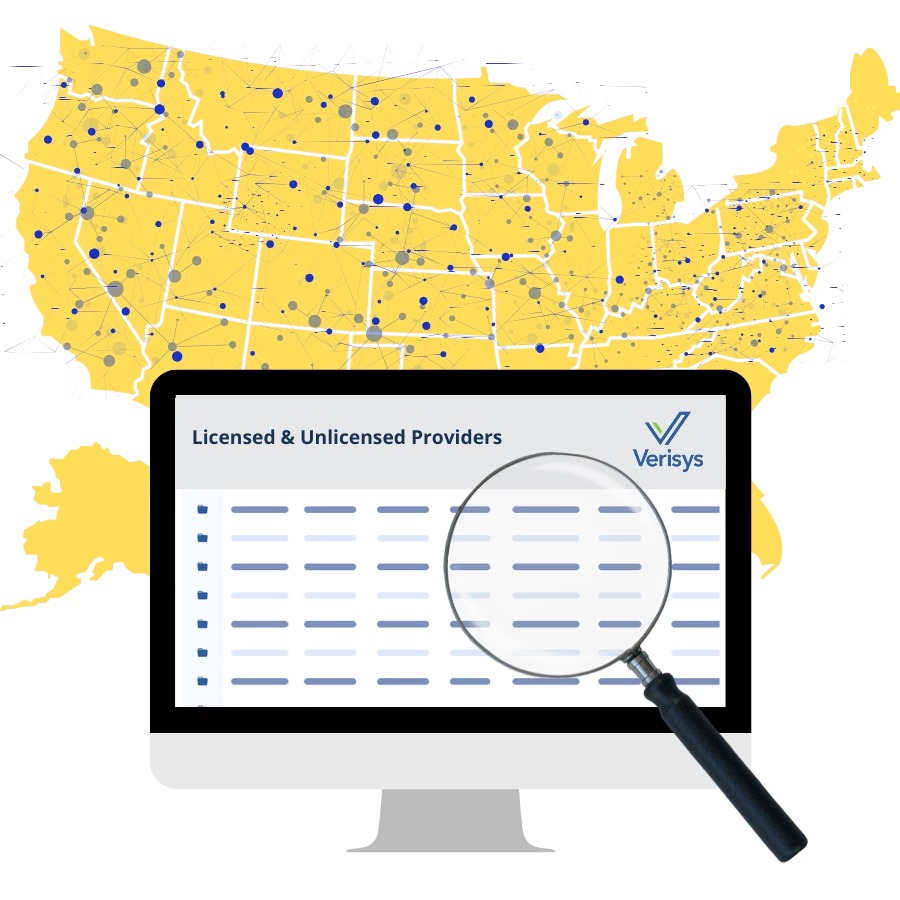
For healthcare organizations with providers licensed in multiple states, this creates a fragmented system where each credential must be tracked independently. Failing to comply with any state’s requirements can jeopardize a provider’s ability to practice there.
A single lapse in one state can delay onboarding, reduce patient access, or even trigger regulatory penalties. It can be even more complicated for organizations managing different types of credentialing, for instance:
- Large Health Systems
- Large health systems often operate hospitals, outpatient clinics, surgical centers, and specialty practices spread across multiple states. This means hundreds (sometimes thousands) of employed providers, each with their unique licensure footprint.
- Every license must be monitored individually, with attention to expiration dates, renewal windows, continuing education requirements, and changing board regulations. The larger the organization, the greater the administrative burden of managing hospital credentialing by state, and the higher the risk of overlooking a key requirement.
- Telehealth Providers
- In a traditional setting, providers were generally licensed only in the state where their facility operated. But with virtual care, providers often see patients from multiple states on any given day. This introduces a credentialing environment where renewal cycles are overlapping and state-specific telehealth regulations can change rapidly.
- As a credentialing team, managing this complexity manually is highly risky. A provider delivering care to a patient in a state where their license has lapsed exposes your organization to serious compliance violations, insurance denials, and patient safety concerns.
- Locum Tenens Groups
- Locum tenens groups face a different set of pressures. Because locum providers move frequently between temporary assignments, credentialing must happen quickly, and often repeatedly, as providers take on roles in different states.
The speed of locum assignments means credentialing teams must operate on compressed timelines while still ensuring nothing is missed. Delays in obtaining or verifying licenses can result in lost assignments, staffing shortages, or disruptions in patient care.
Challenges in Maintaining Multi-State Credentials
As your organization expands across state lines, the credentialing process becomes more complicated.
If your credentialing processes aren’t designed to handle this complexity at scale, it creates major operational challenges for your organization. Some of these challenges include:
Tracking License Expirations and Renewals
One of the most persistent challenges in managing multi-state healthcare compliance is keeping up with license expirations and renewals.
License expirations are not uniform across states. While some licenses renew annually, others operate on biennial or triennial cycles. Sometimes, renewal dates may be tied to a provider’s birthdate, the anniversary of initial licensure, or fixed state calendar dates.
In hospital credentialing by state, missing a renewal deadline can have serious consequences. Providers may face automatic suspension, fines, or extended review periods before reinstatement.
More importantly, healthcare organizations risk legal liabilities if they allow providers to continue practicing without an active license. Even unintentional lapses can trigger payer audits, Medicare or Medicaid penalties, or disciplinary actions from state boards. Use Medicaid provider credentialing software solutions to avoid these penalties.
Managing Unique State Requirements
State licensing requirements go beyond simple deadlines. Some states may mandate additional continuing medical education (CME) credits in specific subject areas, while others require periodic background checks, fingerprinting, or updated malpractice insurance documentation.
Vendor credentialing by state adds another level of complexity, especially for organizations that partner with outside clinicians or contract staff. These third-party providers require close coordination with credentialing staff to ensure that all documentation is accurate, up-to-date, and aligned with state regulations.
Without a clear system in place to monitor and manage these tasks, your credentialing teams will quickly fall behind.
Provider Mobility and Communication Gaps
Physicians and advanced practice providers can hold licenses in multiple states, switch facilities, or take on telehealth assignments across the country. While this flexibility allows healthcare organizations to meet patient needs, it also creates new risks for credentialing teams.
The more providers move, the harder it becomes to maintain a single, up-to-date source for their licensure and credentialing status. Different teams (HR, compliance, credentialing, scheduling) will hold pieces of provider information that aren’t always synchronized. In managing multi-state healthcare credentials, these communication gaps increase the risk of scheduling providers who may unknowingly be non-compliant in certain states.
What starts as a simple oversight can escalate into an operational disruption or compliance violation that could have been avoided with better coordination. Thankfully, hospital credentialing software services can help to close this gap. With a single dashboard, data can be centralized and accessed by all teams.
Tools and Processes for Credential Management
Given all these challenges, healthcare organizations need more than spreadsheets and manual reminders to maintain compliance. They need a modern credentialing solution like Verisys that offers comprehensive tools and processes to streamline multi-state license management.
Below are some of these tools and processes:
Centralized Credentialing Systems
A centralized healthcare provider credentialing solution serves as a single source of storage for all provider data, licensure status, and renewal timelines. It consolidates data into one system, allowing organizations to gain:
- Real-time dashboards that provide instant visibility into credential statuses
- Comprehensive audit trails that document every verification, renewal, and update
- Reduced administrative burden by minimizing data duplication and manual tracking
These centralized systems also make it easier to share consistent information across departments, reducing errors caused by siloed data.
Automated Alerts and Expiration Tracking
One of the most important features of modern credentialing software is automated alerting. With this tool, organizations can configure the system to send notifications to credentialing teams, managers, and providers as renewal dates approach.
These alerts provide a safeguard against missed deadlines, ensuring ample time to complete renewals and avoid costly credentialing issues in advance. Automated systems can also flag incomplete files or expiring certifications, allowing credentialing staff to prioritize workload efficiently.
Integration With HR and Scheduling Systems
When you integrate credentialing platforms with HR, payroll, and scheduling systems, it ensures that only actively credentialed providers are scheduled to work. This cross-system ensures system-wide consistency and prevents accidental assignments of providers with lapsed licenses or incomplete files.
Integration also facilitates faster onboarding of new hires by streamlining license verification during the recruitment process.
Best Practices for Multi-State Compliance
Although credentialing tools are important, they aren’t the ultimate requirement for credentialing success.
The following practices will help you achieve long-term success, combined with tools like healthcare provider data Verification solutions and credentialing software.
Building Standardized Workflows for Renewals
Establish clear, repeatable workflows for each step of the renewal process. Standardization helps ensure that every credential is processed consistently, regardless of the state involved.
Your workflows should define:
- Required documentation for each state
- Internal review timelines
- Submission protocols for state boards
- Escalation paths for missing information
By creating uniform workflows, your credentialing teams can more easily train new staff, scale operations, and reduce variance across renewals.
Assigning Ownership to Credentialing Teams or Managers
Assign specific credentialing coordinators or managers to oversee license portfolios for designated providers or states. This ownership model ensures that someone is always monitoring each credential’s status and proactively managing upcoming deadlines.
Shared responsibility models usually lead to ineffective communication or assumptions that “someone else is handling it.” Whereas, clear ownership reduces these risks.
Using Dashboards to Identify Risk Areas Before Audits
Credentialing dashboards allow leadership teams to monitor compliance health in real time. By flagging expiring licenses, incomplete files, or pending renewals, dashboards help organizations identify risks long before an external audit uncovers them.
This approach allows teams to address issues on their timeline rather than react under pressure from auditors or regulators.
Conclusion: Staying Compliant Across States
Managing provider credentials across multiple states doesn’t have to be overwhelming. With the right combination of centralized systems, automated tracking, clear ownership, and standardized workflows, healthcare providers can learn to stay ahead of the complexity rather than constantly reacting to it.
When your credentialing teams have clear visibility into license statuses, automated reminders for renewals, and standardized workflows for handling state-by-state requirements, they can confidently maintain compliance while reducing administrative strain.
More importantly, staying compliant across states directly supports larger organizational goals. It ensures that your providers are always ready to deliver care, which in turn minimizes disruptions, protects against regulatory risks, and safeguards patient safety.
Sources
Magnet ABA Therapy: Telehealth Statistics https://www.magnetaba.com/blog/telehealth-statistics
CMS https://www.cms.gov/files/document/medqtrlycompnlarchive072019003pdf