Healthcare organizations face many complexities in compliance monitoring: more regulations, more provider types, more data sources, and higher consequences for gaps in verification. Selecting the right compliance data provider directly affects patient safety, regulatory standing, and operational efficiency.
For many organizations, compliance is often treated as a checklist. In practice, it functions as a continuous system, one that depends on strong data, structured workflows, and the right partner to support effective compliance monitoring.
This guide outlines how to choose the right compliance data provider, including the criteria that matter most, the questions to ask, and the risks that arise when compliance data falls short.
Why Compliance Data Matters in Healthcare
Healthcare organizations operate under strict healthcare regulations and oversight from the OIG, CMS, state Medicaid programs, and accreditation bodies like NCQA and the Joint Commission. Each requires documented evidence that providers are properly licensed, credentialed, and free from exclusions or sanctions.
Compliance data underpins this entire framework.
When data is incomplete or outdated, organizations face compounding compliance risks from Civil Monetary Penalties to audit failures. The implications extend beyond regulatory exposure to the organization’s compliance posture and long-term stability.
Organizations that prioritize high-quality data as part of their compliance management framework can identify issues earlier, reduce the compliance burden on internal teams, and support continuous improvement across their compliance journey.
What Is a Healthcare Compliance Data Provider?
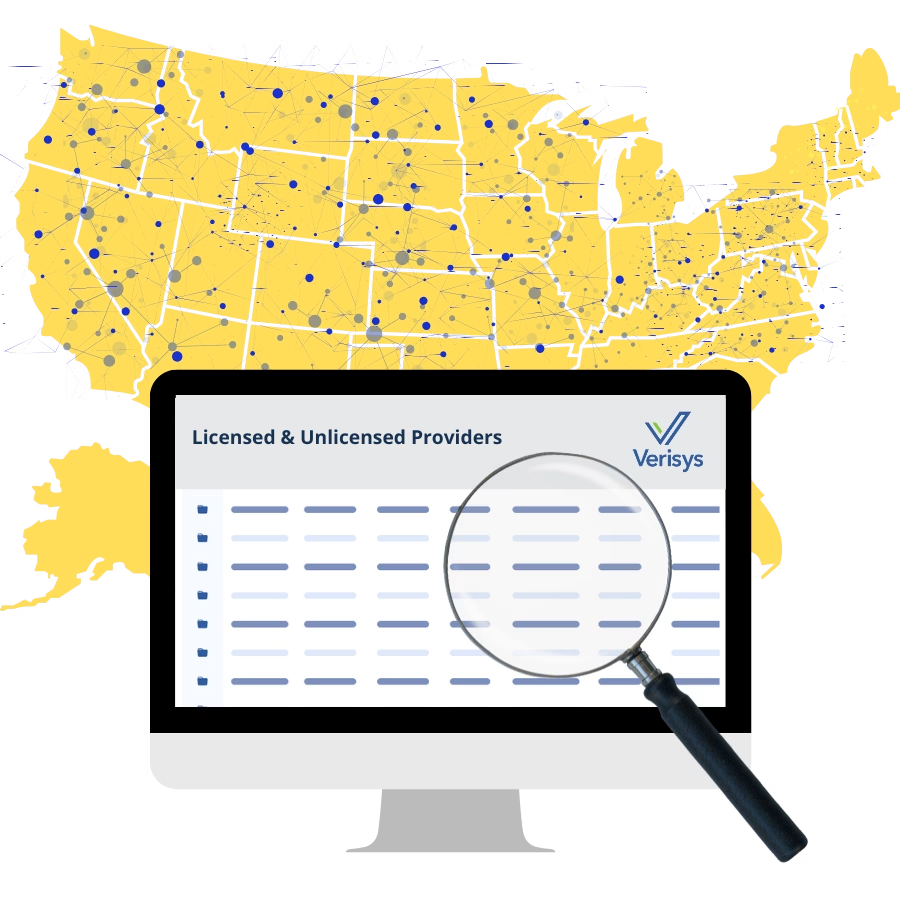
A healthcare compliance data provider specializes in collecting, verifying, and continuously tracking information about medical professionals and healthcare entities. These organizations serve as healthcare data providers that consolidate fragmented regulatory information into actionable datasets.
This model shifts compliance from reactive verification to proactive oversight, allowing organizations to stay up-to-date and act on changes before they impact claims, audits, or patient interactions.
Types of Compliance Data Used in Healthcare
Compliance programs rely on multiple categories of provider data, including:
- Licensure records
- Federal and state exclusion lists
- Sanctions and disciplinary actions
- DEA registrations
- Board certifications
Primary source verification confirms this information directly with issuing authorities, aligning with industry standards and reducing reliance on secondary or outdated records.
Comprehensive data coverage enables more accurate risk assessment and supports compliance professionals in making informed decisions without relying on incomplete or inconsistent inputs.

Why Choosing the Right Data Provider Is Critical
Incomplete or outdated information creates more exposure than it prevents. Incomplete or poorly maintained data introduces hidden risks. Errors in verification or delays in updates can lead to payments tied to ineligible providers, increasing financial liability and audit exposure.
The right compliance partner alleviates administrative strain on teams that are often under-resourced. Rather than manually checking multiple databases, staff can focus on investigating flagged records. Selecting a capable partner enables organizations to scale compliance efforts without proportionally increasing headcount.
Key Criteria Healthcare Organizations Use to Evaluate Compliance Data Providers
When choosing the right credentialing vendor or compliance partner, healthcare organizations should assess each candidate against measurable standards rather than marketing claims.
Data Accuracy and Reliability
Data quality determines whether a compliance program can trust its outputs. Vendors should demonstrate a history of working with primary sources and provide documented methodologies for verification.
Accurate data reduces false positives and missed exclusions, improving audit experience and supporting defensible compliance management.
Breadth of Data Sources
While healthcare exclusion screening often begins with federal exclusion lists, they represent only part of the compliance picture. Compliance includes state-level data, licensing boards, and disciplinary actions across jurisdictions. This broader data coverage enables organizations to identify gaps earlier and maintain a more complete compliance framework.
And what a qualified partner does is support industry-specific requirements and delivers coverage across all relevant sources.
Frequency of Data Updates
Provider status changes frequently, and the compliance monitoring process must reflect that reality. A provider excluded after your last screening cycle can continue delivering care and generating claims until the next check.
Modern solutions, including AI-driven compliance capabilities, support more frequent updates and real-time visibility into changes.
NCQA’s 2025 credentialing standards update reinforces that credentials are dynamic in nature, and that technological advancements in primary source aggregation now enable organizations to work with more recent data.
Healthcare compliance monitoring should match or exceed the update frequency of primary sources. More frequent updates reduce exposure windows and improve the organization’s ability to respond to emerging risks.
Regulatory Compliance and Security Standards
Healthcare data requires rigorous protection. Organizations should verify that potential partners hold relevant certifications:
- HITRUST – Demonstrates advanced cybersecurity maturity beyond basic HIPAA compliance
- SOC 2 Type 2 – Confirms ongoing operational controls for security and availability
- ISO 27001 – Indicates internationally recognized information security management
Integration Capabilities with Healthcare Systems
Data must reach the systems where decisions happen. Compliance data must integrate seamlessly into credentialing systems, HR platforms, and compliance management software.
Flexible delivery options, APIs, portals, and file exchange, support different workflows while enabling better mapping of data across systems.
Integrated data delivery improves efficiency, reduces manual entry, and provides actionable insights directly within operational systems.
Questions Healthcare Organizations Should Ask Data Vendors
Before selecting a partner, compliance officers should pose specific questions to evaluate fit:
- What is your documented accuracy rate?
- How frequently is your data updated?
- Do you cover all jurisdictions and provider types?
- What cybersecurity protocols and certifications do you maintain?
- How does your platform integrate with existing systems?
- How do you resolve potential matches and reduce false positives?
These questions help ensure alignment between vendor capabilities and the organization’s compliance needs while identifying whether the vendor can serve as a long-term advisor.
Risks of Using Incomplete or Inaccurate Compliance Data
Organizations relying on a single data source or infrequent checks accumulate hidden risk. Payments tied to excluded providers, undocumented monitoring, and gaps in verification can result in penalties, reputational damage, and disruption to business practices.
Organizations that fail to prioritize data quality often face higher costs later, through remediation, audits, and operational inefficiencies. They also create regulatory scrutiny and reputational damage.
The consequences of non-compliance in healthcare consistently exceed the investment required for comprehensive compliance monitoring partnerships.
The Role of Comprehensive Data Verification in Provider Screening
Effective screening extends beyond employed staff to screen non-employed provider populations, including ordering and referring physicians, contracted vendors, and first-tier downstream entities. Each population requires verification against relevant federal and state sources.
Verification must continue throughout the relationship, not just at hire or initial credentialing. Workforce management for healthcare supports scalable eligibility checks that catch license lapses, new exclusions, or disciplinary actions between scheduled reviews.
How Healthcare Organizations Use Compliance Data to Improve Decision-Making
Reliable data enables organizations to:
- Maintain audit-ready documentation
- Improve payment integrity
- Reduce manual compliance tasks
- Strengthen risk assessment processes
Advanced analytics further support decision-making by identifying trends, anomalies, and emerging risks across provider populations.
When data is accurate and accessible, compliance becomes an enabler of business growth rather than a constraint, giving organizations a competitive edge in managing risk and scale.
Selecting a Data Provider That Supports Healthcare Compliance
Choosing a compliance data provider requires more than evaluating features—it requires aligning with a partner that supports an organization’s long-term compliance strategy. Organizations that assess vendors against these standards are better positioned for sustainable compliance rather than reactive remediation.
Managing provider data across licensure, sanctions, exclusions, and other regulatory sources is inherently complex, particularly as requirements evolve across jurisdictions. Many organizations are turning to solutions that aggregate and continuously verify this data to reduce manual effort and improve accuracy.
Verisys is one example of a platform designed to support these needs, offering real-time provider data solutions to streamline credentialing, ongoing monitoring, and payment integrity workflows. By consolidating data and automating updates, solutions like Verisys can help healthcare organizations reduce operational risk and administrative burden while supporting higher-quality patient care.
Sources
- OIG. Exclusions FAQs. https://oig.hhs.gov/faqs/exclusions-faq/
- NCQA. NCQA Updates 2025 Credentialing Product Suite. https://www.ncqa.org/news/ncqa-updates-2025-credentialing-product-suite/