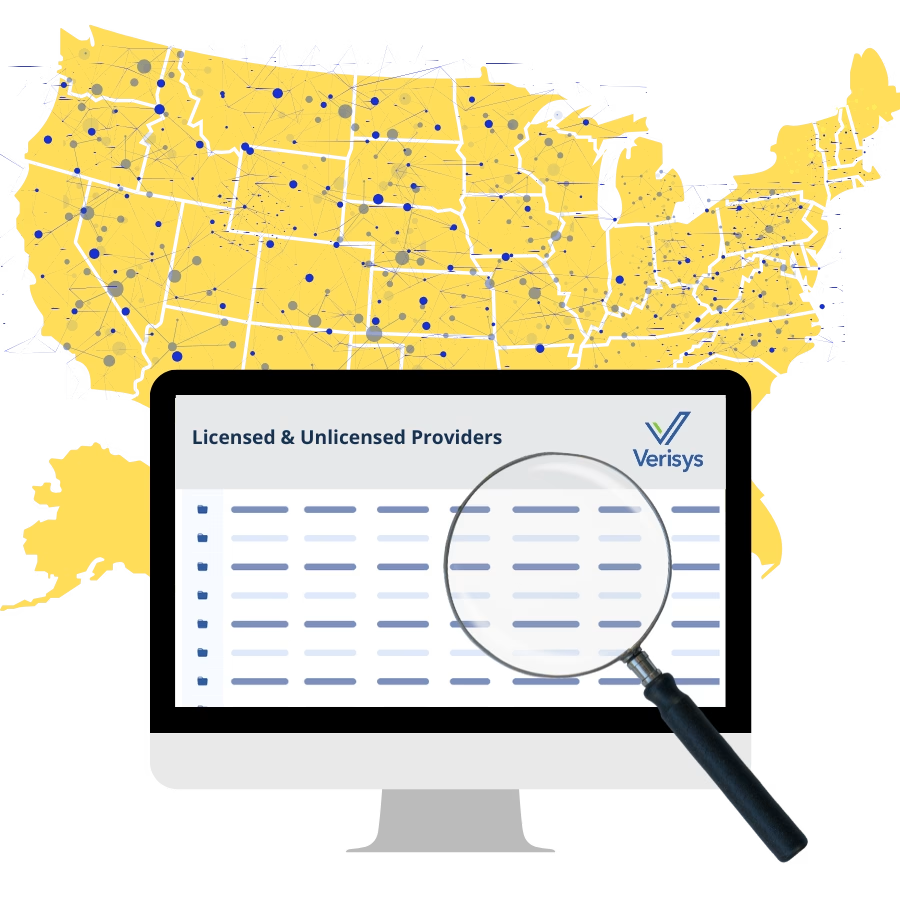
Credentialing challenges for traveling clinicians and other contract healthcare staff often start small: a license is active, but the verification is outdated, or a required document is missing. That kind of last-minute issue can cost a start date, strain a client relationship, and leave a shift uncovered. Across a roster, those gaps add up. If a placement billing $2,500 a week slips two weeks, that’s $5,000 in delayed revenue, and 50 such slips in a year reach $250,000. Solving them means keeping verified data ready before the next placement: primary source verification across every jurisdiction, continuous license and sanctions monitoring, and results delivered into the systems or portal your team already uses. Then you don’t have to keep chasing paperwork.
Why Traveling and Contract Clinicians Are Harder to Credential
Travel nurses, locum tenens physicians, allied health professionals, and other contract clinicians move between employers, facilities, and jurisdictions. Each assignment brings new acceptance criteria, while multiple licenses create separate renewal obligations.
Short contracts leave little room for delays. At scale, frequent arrivals and departures turn one missing verification into a recurring operational problem. Receiving facilities may require fresh verification even when another organization recently reviewed the same credential.
The Core Credentialing Challenges for Healthcare Staffing
These six challenges affect healthcare staffing credentialing from licensure through monitoring.
1. Multi-State Licensure Verification
Start provider license verification by confirming practice authority in every assignment state. The Nurse Licensure Compact lets eligible registered and licensed practical/vocational nurses practice across participating states under one multistate license, issued by their primary state of residence. Nurses who live in non-compact states still need a license in each assignment state. Physicians using the Interstate Medical Licensure Compact still receive separate state licenses.
Many clinicians already hold more than one license. In a survey of 66,054 nurses across five states, 44% held an active license in at least one other state. Confirm primary state of residence, multistate license status, remote-state privileges, and restrictions where applicable. Track each expiration independently since a license can be active and still carry restrictions a status check alone won’t surface.
2. Compressed Assignment Timelines
When coverage is needed within days, a file that takes weeks to complete can derail placement, leaving the agency unable to bill and the facility covering the shift another way. Identify the bottleneck, whether it’s missing references, pending verification, or facility approval.
Faster data retrieval helps, but some reviews still need to run their full course. Run independent tasks in parallel, but make unresolved safety issues a hard stop.
3. Fragmented and Duplicated Documentation
Agencies, managed service providers (MSPs), and facilities may request identical evidence in different formats. Rebuilding packets multiplies rework, while certifications or health documents can expire mid-assignment.
Track document validity against assignment start dates and end dates. Record which version was accepted, by whom, and when, to make sure that a file marked “uploaded” has also been verified.
4. Cross-Jurisdiction Sanctions and Exclusion Risk
A clean record in one state does not show a clinician’s history in another. Review current and historical license actions for possible state-hopping, without treating relocation itself as misconduct.
Include state licensing board actions, which are early indicators of license-level sanctions, as well as federal exclusions and state Medicaid lists; licensing sanctions and exclusions aren’t interchangeable. Match adverse records using identifiers such as date of birth and NPI. Sanction and exclusion screening complements criminal background checks.
5. Facility-Specific Privileging and Onboarding Requirements
A verified agency file doesn’t grant hospital privileges on its own. Locum physicians need applicable privileges, while travel nurses and allied health professionals need role-specific competency validation and orientation. Translate each facility’s Joint Commission or DNV expectations into an assignment checklist.
6. Continuous Monitoring Gaps Between Assignments
A clinician can acquire a restriction between placements, so someone cleared last month may not be clear today. Keep returning candidates in an authorized monitoring roster, and reassess eligibility before redeployment.
Define who owns monitoring during these gaps and how candidates enter or leave the roster.
What These Challenges Cost Agencies and Facilities
Costs reach beyond the credentialing desk: unfilled shifts, lost placement revenue, repeated verification fees, and clinicians who leave for agencies offering firmer start dates.
Compliance exposure can outlast the assignment. Federal programs cannot pay for services furnished by excluded individuals, and improper payments may require repayment, and OIG may assess up to three times the amount claimed for each item or service, plus a per-item penalty. Recent OIG settlements show the scale: $500,019.53 in July 2026 over an excluded nurse at a Colorado Springs provider, and $525,882.88 in August 2026 for two Texas entities that self-disclosed employing an excluded individual. An expired license is a separate problem. A clinician who works past an expiration date is practicing without authority in that state, payers can deny or recoup claims for those services, and the lapse can reach back to every shift since the expiration date.
How to Solve Healthcare Staffing Credentialing Challenges at Scale
Several of these challenges trace back to the same two gaps: evidence that can’t be reused and tasks no one owns.
Build a Portable, Centralized Credential Profile
Create one clinician profile containing:
- Verified credentials
- Source references
- Verification dates
- Expiration dates
- Resolved discrepancies
Then, link each healthcare background check to the correct identity. Reuse acceptable evidence across placements, while preserving each facility’s verification-age rules and approval requirements. Give authorized teams access to the same record instead of circulating another attachment.
Verify From Primary Source Data Across All Jurisdictions
Retrieve licenses and certifications from issuing authorities or accepted primary-source equivalents. For prescribing roles, verify applicable Drug Enforcement Administration (DEA) and controlled dangerous substance (CDS) registrations. Maintain pre-verified pools, but confirm assignment-specific eligibility before promising a start date.
How current your data is still depends on when the source actually publishes it. Store retrieval timestamps so reviewers can judge whether evidence remains acceptable.
Screen and Monitor Continuously, Not Just at Hire
Run healthcare sanction screening at hire and keep it running between assignments. HHS-OIG recommends checking its List of Excluded Individuals and Entities (LEIE) monthly to minimize overpayment and civil monetary penalty liability. An alert only matters if someone is actually assigned to act on it. Route license and sanctions alerts to named reviewers, set escalation deadlines, and record decisions.
Integrate Credentialing Data Into Your Healthcare Staffing Systems
Feed verified results into applicant tracking systems (ATS), vendor management systems (VMS), and credentialing platforms through APIs or secure file exchange. Teams without an integration path can submit through a portal, with reporting and dashboards. Transfer source dates and unresolved alerts, and define who owns updates when systems disagree.
Standardize Requirements Across Client Facilities
Agree on a shared credential checklist with facility-specific addenda. Document accepted evidence, freshness requirements, approval owners, and orientation needs.
Separate credential readiness from completed onboarding. Facilities relying on agency exclusion screening should retain evidence that those checks occurred.
Building a Compliance-Ready Healthcare Staffing Workflow
Use “credential once, monitor continuously, re-verify by exception” as an efficiency principle. Build the profile, verify core credentials, enroll monitoring, compare facility requirements, resolve gaps, and obtain required approval before release.
Track time-to-assignment from accepted offer to cleared start, credential completeness against each facility’s checklist, and alert resolution from notification through documented closure. Review outliers by cause. Otherwise, an improving average can hide a growing queue of difficult files.
Faster Placements Depend on Always-Current Credential Data
Verisys provides the verified provider data behind license verification across 56 U.S. jurisdictions and 800+ provider taxonomies, plus FACIS® sanctions screening and continuous monitoring. API or secure file delivery puts that data inside the systems your team already uses, and portal submission with reporting and dashboards is available for teams that prefer it.
Talk to Verisys about keeping clinician credential data current between placements.